About the Project
Becoming a parent offers a unique opportunity to heal from childhood hurts.
The Healing the Past by Nurturing the Future project is developing perinatal awareness, recognition, assessment and support strategies for Aboriginal and Torres Strait Islander parents experiencing complex childhood trauma.
While there are no systemic perinatal strategies for supporting parents who may be experiencing complex childhood trauma, the frequent contacts with health care providers during pregnancy and the first two years after the baby’s birth offer a unique opportunity to support new parents on their healing journey, and interrupt the cycle of intergenerational trauma.
This project’s goal is to promote healing for the parent and prevent inter-generational transmission of trauma to the child. It will be undertaken in two phases, co-design1 and implementation2 which are indicated throughout with a 1 or 2.
The project will:
- Assess and implement the acceptability, validity, safety and feasibility of recognizing and assessing Aboriginal parents during the perinatal period to identify those experiencing complex trauma.
- Develop and implement acceptable, safe and feasible awareness and support strategies during the perinatal period to support Aboriginal parents experiencing complex trauma.
Purpose and benefits
Having a baby is an exciting time. But it can also be hard, particularly if parents are experiencing complex trauma as a result of hurtful things that have happened in the past.
These effects can be ‘triggered’ during pregnancy and/or the transition to becoming a parent, due to the intimate nature of perinatal care.
Our research and project approach is participatory and collaborative
It involves Aboriginal and Torres Strait Islander people in all stages of the research, including:
- funding submissions
- governance
- project leadership
- data collection
- analysis
- distribution.
Community leaders, service providers, policy makers and families are involved in the co-design process, working with investigators from 12 institutions.
Conceptual framework
We have developed a conceptual framework drawing on holistic Aboriginal constructs of social and emotional wellbeing to illustrate the aims and values of the project, with two main elements.
1. Four main domains of recognition, assessment, awareness and support
The four main domains were developed during the initial consultation stages of the project which revealed concerns about the use of language such as ‘screening’ and ‘intervention’. The domains of ‘recognition’ and ‘assessment’ more accurately articulate ‘screening’ strategies that incorporate a feasible two-tiered process for care providers to recognise parents who may require more in-depth assessment for complex trauma; and ‘intervention’ approaches to improve trauma-informed perinatal care and minimise the risks of re-traumatising parents (awareness), and provide trauma-specific support.
2. Eight core values with related principles and questions
We identified seven frameworks that included trauma-informed values and principles using online searches and team members’ knowledge. Further values and principles relating to cultural and emotional safety were identified in the first key stakeholder workshop. These were mapped and consensus reached by the project team. This process resulted in identification of eight core values: safety, trustworthiness, empowerment, collaboration, culture, holism, compassion and reciprocity. Each contains action-oriented principles that enable the core values to be realised, and are accompanied by questions developed to aid reflection on whether the activity under consideration is consistent with the core value. See HPNF conceptual framework values, principles and reflective questions – Table 1 [PDF 158.66KB]
Research plan
The research plan is designed in accordance with:
- Intervention mapping 1 which uses theory and evidence as the foundations for taking an ecological approach to assessing and intervening in health problems and engendering community participation1. This research addresses steps one to four. Steps five and six (implementation and evaluation) will form the basis of a subsequent project.
- Power threat meaning framework 2(PTMF), “an over-arching structure for identifying patterns in emotional distress, unusual experiences and troubling behaviour, as an alternative to psychiatric diagnosis and classification”. We will incorporate the PTMF by reframing behaviours related to complex trauma as normal self- protective responses to threatening situations rather than pathological deficits.
- Principles for population-based screening3 to assess the benefits, risks, costs, acceptability, accuracy and harms of recognising and assessing parents' experiencing complex trauma.
- Indigenous research methodologies4 that privilege Aboriginal worldviews, self-determination and Aboriginal community control.
References
- Bartholomew Eldrigde LK, Markham CM, Ruiter RAC, et al. Planning health promotion programs: An Intervention Mapping approach. 4 ed. Hoboken, NJ: Wiley 2016.
- Johnstone L, Boyle M, Cromby J, et al. The Power Threat Meaning Framework: Towards the identification of patterns in emotional distress, unusual experiences and troubled or troubling behaviour, as an alternative to functional psychiatric diagnosis. Leicester: British Psychological Society, 2018.
- Australian Health Ministers' Advisory Council. Population based screening framework. Barton: Commonwealth of Australia, 2008.
- Rigney L. Indigenous Australian views on knowledge production and Indigenist research. In: Runnie J, Goduka N, eds. Indigenous peoples' wisdom and power: Affirming our knowledge. Burlington, USA: Ashgate Publishing 2006:32-48.
Partners
This collaborative research involves investigators from many universities and health services organisations, including:
- University of Melbourne 1,2
- La Trobe University 1,2
- We Al-li Pty Ltd 1,2
- Orygen 1,2
- South Australian Health and Medical Research Institute 1,2
- Charles Darwin University 2
- Australian National University 2
- University of South Australia 2
- Lowitja Institute 2
- University of Adelaide 1
- Flinders University 1
- James Cook University 1
- Monash University 1
- Victorian Aboriginal Health Service 1
- Murdoch Children’s Research Institute 1
- Victorian Aboriginal Child Care Agency
- La Trobe Regional Hospital
- Southern Cross University
- Murdoch University
- University of Newcastle
Note: 1 and 2 refers to the project phases.
About the artwork
Songs of Strength
Ink on paper, 2018, Shawana Andrews
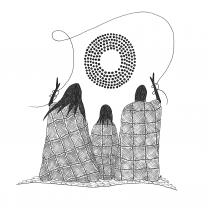
A father, mother and child wearing possum skin cloaks and looking to the ancestors and past generations. The parents are connected with a songline which gives them strength. The stones below represent a strong foundation and the stitching on the cloaks represent the relational connectedness of Aboriginal people and worldview.
Cultures Child
Ink on paper, 2018, Shawana Andrews
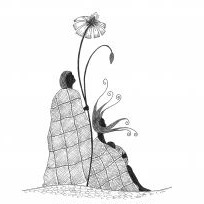
A father, mother and child wearing possum skin cloaks sitting by a myrnong daisy, the father holds the stem and looks to the daisy as it holds history and knowledge of the ancestors, this gives him strength.
The mother holds a newborn and rests against the stem, it supports her. Mother and father are on different sides of the stem representing their different paths and roles in caring and nurturing for children. The daisy is in flower but also has a new bud and speaks of future generations and continuity.
The stones below represent a strong foundation of many generations and the stitching on the cloaks represent the relational connectedness of Aboriginal people and worldview. The mother's hair blows in the wind, representing change.