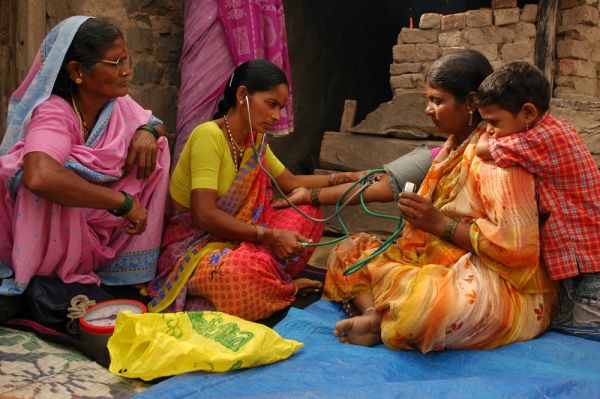
Learn about health in low-resource settings and how communities can be empowered to change at the renowned Jamkhed Institute in rural India.
The Comprehensive Rural Health Project (CRHP) in Jamkhed, India has won global acclaim and provided inspiration for the seminal Declaration of Alma Ata (1978). It remains one of the world’s most influential and innovative comprehensive community health and development programs.
This course is designed for public health, medical, nursing, allied health, development studies or social work students, and anyone who is keen to learn about health in resource-poor settings.
Overview
Since 2004, the Nossal Institute and the CRHP have run three-week courses on Primary Health Care (PHC) at the Jamkhed Institute in Maharashtra state, India. More than 400 students have so far completed the course.
In this 3 week residential course, participants will learn about the Jamkhed Model while living in the resource-poor context of central Maharashtra, India.
Participants will:
- engage with and critically analyse the Jamkhed approach to community health and development via: field visits to villages and project sites; seminars and discussions with project staff, lay volunteers, local health and development professionals and researchers; and interactive observations and teaching with university staff.
- gain a thorough understanding of the context and history of comprehensive primary health care as a movement, and its applications within the Indian context.
- acquire detailed knowledge of how the CRHP has applied a community-based, integrated multi-sectoral action, utilising a deep understanding of local culture and needs to address a wide range of issues. These include mortality and morbidity, poverty, gender inequity, and water and sanitation. Participants will learn how to apply these principles in the design of programs seeking to address a variety of global health problems and contexts.
Ravi Arole, Director Comprehensive Rural Health Project shares why this experience is so valuable.
Course structure
Course outline
Intended learning outcomes
On completion of this course, participants should be able to:
- Evaluate health organisations and systems utilising the principles of community-based primary health care as a framework;
- Analyse the role of participatory approaches in identifying and addressing health needs;
- Analyse the socio-cultural, economic and political determinants of health in rural India;
- Evaluate the Comprehensive Rural Health Project's culturally embedded, multi-sectoral approach to health programming;
- Apply the Jamkhed model of community-based health programming to other global health settings.
Course leaders
Course Dates
2026
15 November 2026 to 5 December 2026
Fees
This subject can be taken as a short course or for academic credit with assessment with the University of Melbourne.
Please read the Information Sheet for full information on the course, including fees, eligibility requirements and travel considerations before applying.
Information Sheet
Applications
Applications for the 2026 Course are now open. Admission to the course is on a first-come, first-served basis. Please read the 2026 Student Information Sheet carefully before submitting your application.
Further information
Please contact: mreeve@unimelb.edu.au OR daniel.strachan1@unimelb.edu.au
NB: For those interested in this subject but unable to travel for any reason, please do consider Primary Health Care: Applied Principles (POPH90131) . This two-week intensive subject held in February focuses on the same key principles that underpin the Comprehensive Rural Health Project in Jamkhed.