CONTENT WARNINGThis website may contain the names and images of Aboriginal and Torres Strait Islander people now deceased. It also contains links to sites that may use images of Aboriginal and Islander people now deceased. We apologise for any distress that may occur. |
ACKNOWLEDGEMENT OF COUNTRY
"We would like to acknowledge the Wurundjeri people of the Kulin Nation as the Traditional Owners of the land on which our Melbourne office is located and acknowledge the Arrernte people of Central Australia and the Larrakia people of Darwin as the Traditional Owners of the lands where our staff are based."
"We pay our respects to Elders past and present and extend that respect to all Aboriginal and Torres Strait Islander Australians, particularly those who have made and continue to make contributions to the work to Close the Gap for Vision."
Minum Barreng: Indigenous Eye Health Unit supports the Uluru Statement from the Heart including a First Nations Voice to Parliament
Minum Barreng at The University of Melbourne accepts the invitation of the Uluru Statement from the Heart and supports its implementation in full (Voice, Treaty, Truth), which includes support for a First Nations Voice to Parliament enshrined in the Australian Constitution.
Minum Barreng: Indigenous Eye Health Unit
Minum Barreng was established in 2008 by Professor Hugh Taylor, AC at the Melbourne School of Population and Global Health to undertake world-leading research that has established an evidence-base and policy framework to address Indigenous eye health in Australia.
Minum Barreng aims to Close the Gap for Vision and eliminate unnecessary vision loss and blindness for the Aboriginal and Torres Strait Islander peoples through research, policy formation, advocacy and implementation. The research established the state of Indigenous eye health in Australia and current service availability and explored barriers and enablers to the delivery of eye health services for Indigenous peoples.
The evidence gathered guided the development of a comprehensive policy framework – The Roadmap to Close the Gap for Vision - that is supported by the Indigenous and mainstream health sectors and government. Minum Barreng is currently actively engaged in providing the necessary advocacy and technical support to Close the Gap for Vision, including eye health promotion and First Nations self-determination and leadership of eye health and care.
Minum Barreng is proudly part of Onemda: Aboriginal and Torres Strait Islander Health and Wellbeing. Onemda specialises in research and teaching in Indigenous public health supported by community partnerships and collaborations and strong ethical foundations.
Join Minum Barreng Communications Mailing List
Order Trachoma Book Order Minum Barreng Book
Quick Links
-
Minum Barreng: Indigenous Eye Health Unit is committed to strengthening First Nations leadership and supporting self-determination in eye health. For several years, we have worked deliberately to shift power, amplify First Nations voices, and transition leadership, resources and decision-making authority to First Nations organisations.
-
The 2025 National Aboriginal and Torres Strait Islander Eye Health Conference (NATSIEHC25) will be held 27 - 29 May 2025 | Boorloo (Perth, Western Australia) on Whadjak Noongar Country.
-
Healthy housing and homes are critical determinants of health and wellbeing, and this project page describes some of Minum Barreng’s involvement in activities that support individuals, families and communities' access to functional washing facilities and healthy living environments, particularly as they relate to trachoma elimination.
-
The aim of this evaluation is to establish recommendations for future health promotion approaches in trachoma beyond June 2024 including improvements to current approaches with consideration for efficiency, effectiveness and appropriateness.
-
In 2019, The Indigenous Eye Health Unit (IEHU) commenced a formal evaluation of regional implementation of The Roadmap to Close the Gap for Vision (the Roadmap). Independent evaluators have been engaged to carry-out elements of this work and an experienced facilitator is supporting the co-design process.
-
IEHU are pleased to announce the launch of the 2021 Annual Update on the Implementation of The Roadmap to Close the Gap for Vision.
-
Our work
-
Roadmap
Progress and resources to support the implementation of the Roadmap to Close the Gap for Vision.
-
Health Promotion
Health promotion resources to support community awareness of refractive error (need for glasses), cataract, diabetic retinopathy and trachoma. The resources are free to order, download, and/or adapt for local community settings, language and country.
-
Projects
Minum Barreng works to eliminate trachoma in Australia, close the gap for vision, strengthen Aboriginal and Torres Strait Islander leadership in eye health, and end avoidable vision loss and blindness. This work is delivered through interrelated projects, including the MFC partnership, A Place for Mob, A Place for Me in Optometry, transition to Indigenous leadership, and healthy housing and homes.
- MB:IEHU Head, Associate Professor Mitchell Anjou

Minum Barreng: Indigenous Eye Health Unit Head
- Address
- Minum Barreng: Indigenous Eye Health Unit
- Onemda: Aboriginal and Torres Strait Islander Health and Wellbeing
Melbourne School of The University of Melbourne
Level 5, 207 Bouverie Street, Carlton, Victoria, 3010, Australia
- Telephone
- +61 3 8344 0322
- Email Indigenous-EyeHealth@unimelb.edu.au
- Facebook Indigenous Eye Health Unit - IEHU
- Twitter IEHU_Unimelb
- LinkedIn Indigenous Eye Health Unit
- Instagram IEHU_Unimelb
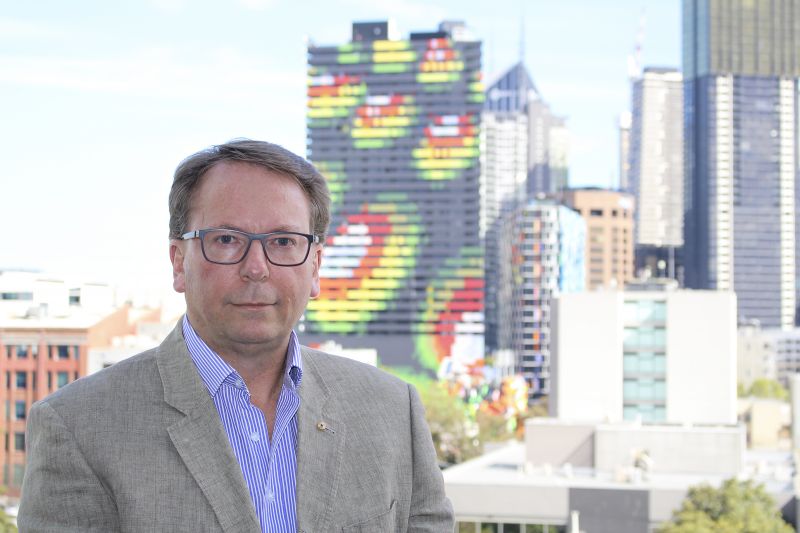
About Minum Barreng: Indigenous Eye Health Unit
Minum Barreng: Indigenous Eye Health Unit (Minum Barreng) was established in 2008 in the Melbourne School of Population and Global Health of The University of Melbourne to undertake world-leading research developing an evidence base and policy framework and then toimplement systems reform and health promotion that supported improvements in Aboriginal and Torres Straits Islander eye health in Australia. Minum Barreng operates now to enable Aboriginal and Torres Strait Islander determination, ownership and leadership of Aboriginal and Torres Strait Islander eye health.
The Head of Minum Barreng is Associate Professor Mitchell Anjou.
The leadership team at Minum Barreng comprises Shaun Tatipata, Emma Stanford and Mitchell Anjou.
Minum Barreng is proudly part of Onemda: Aboriginal and Torres Strait Islander Health and Wellbeing. Onemda specialises in research and teaching in Indigenous public health supported by community partnerships and collaborations and strong ethical foundations.
Our Team
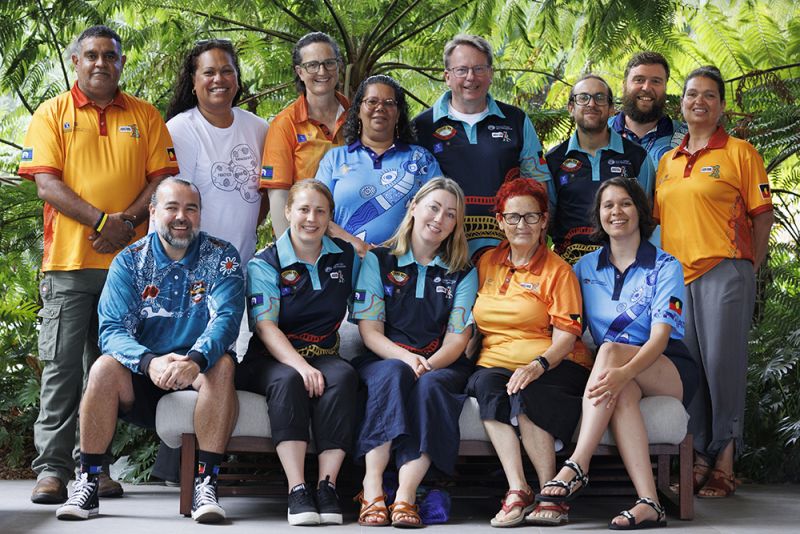
Our team comprises knowledge translation scholars and researchers, health promotion and community engagement officers and administrative staff.

Governance
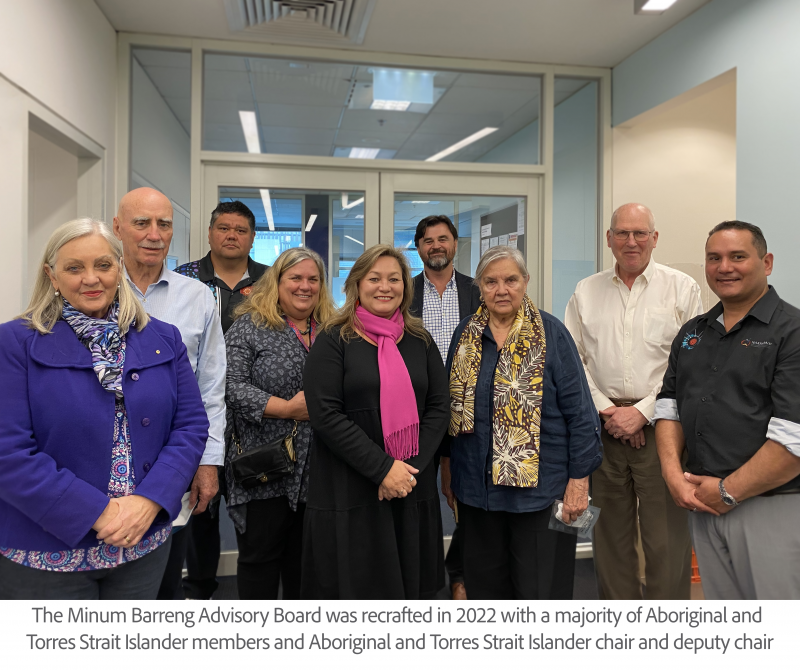
The Minum Barreng: Indigenous Eye Health Unit Advisory Board was established in 2008 and provided valued strategic direction and leadership for Minum Barreng up to 2025. The Advisory Board retired in 2025 given the downsizing of Minum Barreng activities and staffing and provided specific endorsement of some immediate future activities including the transition of work to First Nations organisations.
Minum Barreng Supporters and Donors
The work of Minum Barreng is generously supported by a number of private donors, philanthropic trusts, the Australian Government Department of Health and Aged Care and The University of Melbourne.
CONTENT WARNINGThis website may contain the names and images of Aboriginal and Torres Strait Islander people now deceased. It also contains links to sites that may use images of Aboriginal and Islander people now deceased. We apologise for any distress that may occur. |
CONTENT WARNINGThis website may contain the names and images of Aboriginal and Torres Strait Islander people now deceased. It also contains links to sites that may use images of Aboriginal and Islander people now deceased. We apologise for any distress that may occur. |
About the Roadmap
Minum Barreng: Indigenous Eye Health Unit (Minum Barreng) undertook The Roadmap to Close the Gap for Vision project to review health service provision and develop a model of eye care for Indigenous Australians for presentation to the Australian Government.
The project outcomes are documented in The Roadmap to Close the Gap for Vision, released in 2012, which includes a sector-endorsed, evidence-based, whole-of-system framework that collectively seeks to address Indigenous eye health inequity and Close the Gap for Vision.
Explore Our Roadmap Resources
-
The Roadmap to Close the Gap for Vision
Here you will find the Roadmap Summary reports and the full Roadmap to Close the Gap for Vision report.
-
Annual Update on the Implementation of The Roadmap to Close the Gap for Vision
Here you will find the current and past years Annual Update on the Implementation on the Roadmap to Close the Gap for Vision reports.
-
Regional Implementation Toolkit
This Regional Implementation Toolkit provides a range of resources to assist communities and services to calculate, plan and monitor improved eye health outcomes for regional areas throughout Australia.
-
Position Papers and Information Sheets
The full set of the Indigenous Eye Health’s Position Papers on various issues and policy matters.
-
National Aboriginal and Torres Strait Islander Eye Health Conference (NATSIEHC)
Find all the relevant information regarding the Close the Gap for Vision by 2020 National Conference and the previous years reports and conference wrap-up.
-
Evaluating Regional Implementation of The Roadmap
Independent evaluators have been engaged to carry-out elements of this work and an experienced facilitator is supporting the co-design process.
-
Technical Reports
Here you will find technical reports from IEH and external stakeholders.
-
Jurisdictional Snapshots
The snapshots include analysis of measures on eye health and access to eye care services for Indigenous Australians at both jurisdictional and Primary Health Network level. Minum Barreng published snapshot reports in 2018, 2021, 2022 and 2023. From 2024, AIHW began publishing jurisdictional eye health measures reports (InFocus reports for states and territories).
-
'Share Your Story': Success Stories
A selection of ‘stories’ of successful activities and significant achievements in Indigenous eye health by individuals, organisations, regional stakeholder groups, and through other collaborations relating to efforts to close the gap for vision.
-
'Asking the Question' (AtQ)
Resources to promote appropriate identification of Aboriginal and Torres Strait Islander status to improve eye care service delivery in mainstream practices and clinics
ACKNOWLEDGEMENT OF COUNTRY
"We would like to acknowledge the Wurundjeri people of the Kulin Nation as the Traditional Owners of the land on which our Melbourne office is located and acknowledge the Arrernte people of Central Australia and Larrakia people of Darwin as the Traditional Owners of the lands where our staff are based."
"We pay our respects to Elders past and present and extend that respect to all Aboriginal and Torres Strait Islander Australians, particularly those who have made and continue to make contributions to the work to Close the Gap for Vision."

CONTENT WARNINGThis website may contain the names and images of Aboriginal and Torres Strait Islander people now deceased. It also contains links to sites that may use images of Aboriginal and Islander people now deceased. We apologise for any distress that may occur. |
About Health Promotion
Eye health promotion resources developed by the Minum Barreng: Indigenous Eye Health Unit (Minum Barreng) support community awareness of the main eye health conditions affecting Aboriginal and Torres Strait Islander people.
The main causes of vision loss for Aboriginal and Torres Strait Islander people include refractive error (the need for glasses), cataract and diabetic retinopathy. Trachoma can lead to blindness and remains a significant issue in some remote communities, where repeated trachoma infections may result in trichiasis.
Regular eye checks, early detection and treatment help to prevent this unnecessary vision loss and blindness.
A variety of print and multimedia resources have been developed by Minum Barreng to assist in eye health promotion, community engagement and education.
Minum Barreng acknowledges the contributions and guidance of Aboriginal and Torres Strait Islander community members and community-controlled organisations who shared their knowledge, expertise and lived experience to develop these resources.
The eye health promotion resources are free to order, download, and/or adapt for local community settings, language and country.
For more information or to get in touch about Minum Barreng eye health promotion resources email: Indigenous-EyeHealth@unimelb.edu.au
Explore our Health Promotion Resources
-
Check Today, See Tomorrow
Resources to support awareness of diabetes eye care and promote the importance of YEARLY eye checks for Aboriginal and Torres Strait Islander people with diabetes
-
Eyecare Now, Eyecare Always
Resources to promote regular eye checks through the annual MBS 715 health check and support awareness of cataract and refractive error (need for glasses)
-
Clean Faces, Strong Eyes
Resources to support awareness of trachoma and promote the importance of facial cleanliness and good hygiene to stop trachoma and other infections
-
Milpa's Six Steps to Stop Germs
‘Milpa’s Six Steps to Stop Germs’ is a suite of resources aimed to encourage everyone, particularly kids, to stay healthy and strong and eliminate trachoma and other infectious diseases through following Milpa’s Six Steps to Stop Germs.
-
'Asking the Question' (AtQ)
Resources to promote appropriate identification of Aboriginal and Torres Strait Islander status to improve eye care service delivery in mainstream practices and clinics
-
Order Resources
A variety of free resources is available to support eye health promotion, community engagement and education.
-
Order T-shirts
Health promotion t-shirts are available to order. It includes the option to add your organisation’s logo
-
Adapt Resources
Resources can be adapted to develop additional, localised materials to support community engagement and awareness of eye health
ACKNOWLEDGEMENT OF COUNTRY
"We would like to acknowledge the Wurundjeri people of the Kulin Nation as the Traditional Owners of the land on which our Melbourne office is located and acknowledge the Arrernte people of Central Australia and the Larrakia people of Darwin as the Traditional Owners of the lands where our staff are based."
"We pay our respects to Elders past and present and extend that respect to all Aboriginal and Torres Strait Islander Australians, particularly those who have made and continue to make contributions to the work to Close the Gap for Vision."
CONTENT WARNINGThis website may contain the names and images of Aboriginal and Torres Strait Islander people now deceased. It also contains links to sites that may use images of Aboriginal and Islander people now deceased. We apologise for any distress that may occur. |
About Minum Barreng's Projects
Minum Barreng works to eliminate trachoma in Australia, close the gap for vision, strengthen Aboriginal and Torres Strait Islander leadership in eye health, and end avoidable vision loss and blindness. This work is delivered through interrelated projects, including the MFC partnership, A Place for Mob, A Place for Me in Optometry, transition to Indigenous leadership, and healthy housing and homes.
Join Our Mailing Lists:
Explore our Current Projects
-
Roadmap
Progress and resources to support the implementation of the Roadmap to Close the Gap for Vision.
-
Health Promotion
Health promotion resources to support community awareness of refractive error (need for glasses), cataract, diabetic retinopathy and trachoma. The resources are free to order, download, and/or adapt for local community settings, language and country.
-
'Share Your Story': Success Stories
A selection of ‘stories’ of successful activities and significant achievements in Indigenous eye health by individuals, organisations, regional stakeholder groups, and through other collaborations relating to efforts to close the gap for vision.
-
‘A Place for Mob and a Place for Me in Optometry’
A safe space for Aboriginal and/or Torres Strait Islander people journeying into optometry to connect, yarn, collaborate and network. Unpacking meaningful resources that mob could find valuable when seeking career pathways toward optometry.
-
Evaluation of Trachoma Health Promotion
The aim of this evaluation is to establish recommendations for future health promotion approaches in trachoma beyond June 2024 including improvements to current approaches with consideration for efficiency, effectiveness and appropriateness.
-
Healthy Housing and Homes
Healthy housing and homes are critical determinants of health and wellbeing, and this project page describes some of Minum Barreng’s involvement in activities that support individuals, families and communities' access to functional washing facilities and healthy living environments, particularly as they relate to trachoma elimination.
-
Minum Barreng: Transition to First Nations Leadership
Minum Barreng: Indigenous Eye Health Unit is committed to strengthening First Nations leadership and supporting self-determination in eye health. This page outlines some of our transition journey and links to the key areas of work shaping this shift.
-
Melbourne Football Club Partnership
Minum Barreng has a long standing partnership with the Melbourne Football Club, going back to 2010, and continues to actively work with the football club supporting community engagement and health promotion, with a particular focus on trachoma elimination in Central Australia.
ACKNOWLEDGEMENT OF COUNTRY
"We would like to acknowledge the Wurundjeri people of the Kulin Nation as the Traditional Owners of the land on which our Melbourne office is located and acknowledges the Arrernte people of Central Australia and the Larrakia people of Darwin as the Traditional Owners of the lands where our staff are based."
"We pay our respects to Elders past and present and extend that respect to all Aboriginal and Torres Strait Islander Australians, particularly those who have made and continue to make contributions to the work to Close the Gap for Vision."
There are currently no opportunities available at the Minum Barreng right now. |
|---|