Epidemic preparedness and response
Project Details
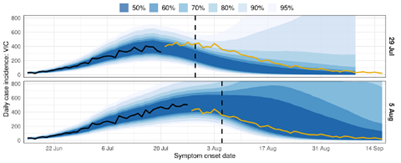
Mathematical modelling and data analytics play a critical role in epidemic and pandemic preparedness and response research and policy decision support, as most recently demonstrated by the COVID-19 pandemic.
Our team develops and applies data analytic methods and open-source research software for understanding the status of an epidemic in real-time, predicting its likely future course, and exploring the potential for interventions to reduce disease burden.
Our current projects include the development and application of methods for:
● Early outbreak detection for emerging infections
● Estimating key epidemiological quantities of endemic and emerging infections (such as growth rates, infection incidence, reproduction numbers etc.)
● Nowcasting and forecasting of established respiratory viruses including influenza, SARS-CoV-2, and respiratory syncytial virus (RSV)
● Scenario analysis, including multi-model synthesis and evaluation
A common theme across the research activities outlined above is the leveraging of data from multiple surveillance studies/systems (or populations) to enhance prediction and improve public health decision support.
Researchers
Prof Nick Golding
Mr Ruarai Tobin
Collaborators
Dr Peter Dawson (Defence Science and Technology Group)
Dr Saras Windecker (The Kids Institute)
Mr Yang Yue
Mr Kartik Kamboj
Funding
DMTC, Australian Research Council, NHMRC
Research Outcomes
Ryan GE, Shearer FM, McCaw JM, McVernon J & Golding N (2024). Estimating measures to reduce the transmission of SARS-CoV-2 in Australia to guide a “National Plan” to reopening. Epidemics, 47(100763), 100763. https://doi.org/10.1016/j.epidem.2024.100763
Shearer FM, McCaw JM, Ryan GE, Hao T, Tierney NJ, Lydeamore MJ, Wu L, Ward K, Ellis S, Wood J, McVernon J, & Golding N (2024). Estimating the impact of test-trace-isolate-quarantine systems on SARS-CoV-2 transmission in Australia. Epidemics, 47(100764), 100764. https://doi.org/10.1016/j.epidem.2024.100764
Conway E, Walker CR, Baker C, Lydeamore MJ, Ryan GE, Campbell T, Miller JC, Rebuli N, Yeung M, Kabashima G, Geard N, Wood J, McCaw JM, McVernon J, Golding N, Price DJ, & Shearer FM (2023). COVID-19 vaccine coverage targets to inform reopening plans in a low incidence setting. Proceedings of the Royal Society B. https://doi.org/10.1098/rspb.2023.1437
Shearer FM, Walker CR, Tellioglu N, McCaw JM, McVernon J, Black A, & Geard N (2022). Rapid assessment of the risk of SARS-CoV-2 importation: case study and lessons learned. Epidemics, 38(100549), 100549. https://doi.org/10.1016/j.epidem.2022.100549
Moss R, Wood J, Brown D, Shearer FM, Black AJ, Glass K, Cheng AC, McCaw JM, & McVernon J (2020). Coronavirus disease model to inform transmission-reducing measures and health system preparedness, Australia. Emerging Infectious Diseases, 26(12), 2844–2853. https://doi.org/10.3201/eid2612.202530
Shearer FM, Moss R, McVernon J, Ross JV, & McCaw JM (2020). Infectious disease pandemic planning and response: Incorporating decision analysis. PLoS Medicine, 17(1), e1003018. https://doi.org/10.1371/journal.pmed.1003018