Calls to set global targets for anaemia reduction
Despite being a common global health problem affecting 1.9 billion people worldwide, an international team of experts says anaemia remains chronically under-addressed.
In a new Lancet Haematology Commission on Anaemia, led by the University of Melbourne’s Professor Sant-Rayn Pasricha, experts call for a new set of global anaemia targets and make a number of recommendations to better address the problem.
Anaemia is a condition where the number of red blood cells or the haemoglobin concentration within them is lower than normal, which can result in significant fatigue and weakness, among other symptoms, disrupting wellbeing and day-to-day life.
“Children, adolescent girls and women are particularly impacted by anaemia,” Professor Pasricha, Head of the Melbourne School of Population and Global Health, said.
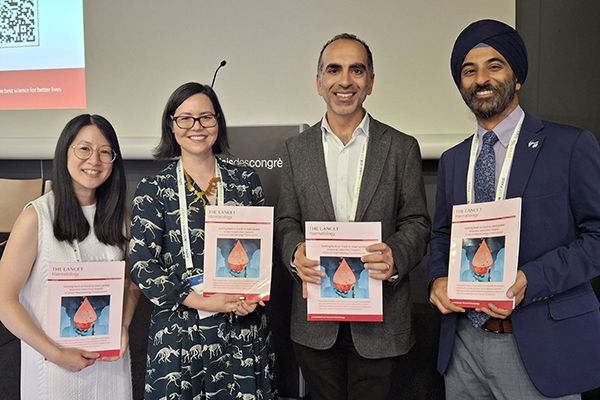
Dr Cheryl Lai Acting Deputy Editor of Lancet Haematology, Dr Lan-Lan Smith Editor in Chief of Lancet Haematology, Professor Sant-Rayn Pasricha and Professor Parminder Suchdev (co-lead of the Commission).
The World Health Organization and the United Nations have set ambitious targets to reduce anaemia in women globally by 50%.
“Most countries are not on track to meet global anaemia reduction targets, suggesting a failure to prioritise this common and serious health issue,” Professor Pasricha said.
“Despite longstanding interventions and guidelines, our failure to make significant progress indicates a need to reinvigorate efforts and address key gaps in data, evidence, interventions, implementation, governance and target-setting approach.”
Professor Pasricha said the issue is compounded by reduced global health funding in 2025, which further threatens our progress against anaemia.
He said there are a variety of reasons why people can become anaemic, and yet there are significant gaps in knowledge and data collection on the numbers worldwide.
“Continued investment is crucial to effectively manage this widespread health issue,” he said.
“As 2030 marks the conclusion of current international development goals, we're reassessing anaemia targets.
“Our research shows the universal 50% reduction goal is not feasible. We propose a new framework for post-2030 targets, with country-specific goals that balance ambition and achievability.”
Key recommendations of the commission include enhancing routine data collection, redefining and adopting collaborative anaemia reduction targets, enhanced investment in interventions that can directly reduce anaemia such as food fortification and iron supplements, and indirectly reducing anaemia through improved access to treatment for heavy menstrual bleeding, post-partum haemorrhage and malaria, and increasing investment in anaemia research.