Addressing suicide in Southeast Asia
More than 300,000 suicides occur every year in Southeast Asia, twice as many as AIDS and maternal deaths combined, representing a complex public health tragedy. Despite global suicide rates reducing 33% since 1990, suicide rates remain stubbornly high in many parts of Southeast Asia, with a suicide rate 60% higher than the global average.
The development of National Suicide Prevention Strategies have been identified as a proven systematic, evidence based response to preventing suicide that combines both community based approaches and government policy. The International Association for Suicide Prevention has initiated Partnerships for Life networks as a platform for sharing knowledge from within the region, supporting collaboration, and enhancing regional leadership and advocacy to build national suicide prevention Strategies for member countries.
The inaugural Southeast Asia Regional Suicide Prevention Network meeting was held in Goa, India in February 2024. Representatives from 8 of the member states of the World Health Organization Southeast Asia Region: Bangladesh, Bhutan, India, Indonesia, Maldives, Myanmar, Nepal and Sri Lanka attended.
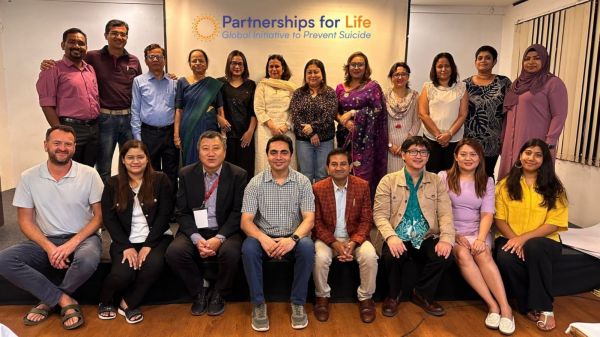 Representatives from Bangladesh, Bhutan, India, Indonesia, Maldives, Myanmar, Nepal and Sri Lanka attended the meeting.
We have the most beautiful plans, but no action.
Discussions revealed the emerging appetite for addressing suicide in Southeast Asia is hampered by: resource constraints, competing priorities, a lack of political will, low quality data, the stigma and shame surrounding suicide, and a reliance on knowledge developed in ‘Western’ settings. There has also historically been a narrow focus on clinical mental health service provision, rather than community and population-level public health interventions. There has been considerable effort to develop national suicide prevention strategies and several modest initiatives are up and running. However, in most cases there has been no funding attached to the plans, and several draft plans were sitting idle waiting for ministerial sign-off.
The energy and expertise in the room was inspiring and is now being harnessed through a collaboration to develop a baseline analysis of suicide prevention planning and activity in the region, to inform future regional leadership and advocacy activities.
A/Prof Greg Armstrong, a researcher with the Social & Cultural Dimensions of Health Systems team, has undertaken collaborative suicide prevention research in India over the past 10 years, with a special interest in public health approaches to suicide prevention. Greg attended the regional meeting and has been coordinating the development of a regional network in the Pacific Islands.