In the latest instalment of Share Your Story you can read about how Emma Dargin, an Aboriginal Health Practitioner (AHP) at Condobolin's Aboriginal Health Service helped to save the sight of a patient with diabetic eye disease using her skills in retinal photography triaging and primary care eye health, during recent COVID-19 restrictions.
Fiona Lange and Rebecca Cooney &..... all contributed to this instalment of 'Share Your Story: Success Story'.
Through some trachoma field during 2006-7 in the Katherine region, Professor Hugh Taylor worked with Dr Andrew Bell the Medical Director of Katherine West Health Board (KWHB). By 2008 trachoma prevalence was found to be 21% in Australia and there was a lack of culturally appropriate, standardised clinical and educational materials for new trachoma screening and treatment programs.
The Management and Board of KWHB including the Ngumbin Reference Group (NRG) agreed to help develop trachoma resources with Indigenous Eye Health (IEH) and the Centre for Disease Control in the NT Department of Health. The goal was to create a complete ‘toolkit’ for clinic, school and community education for regional trachoma programs across Australia.
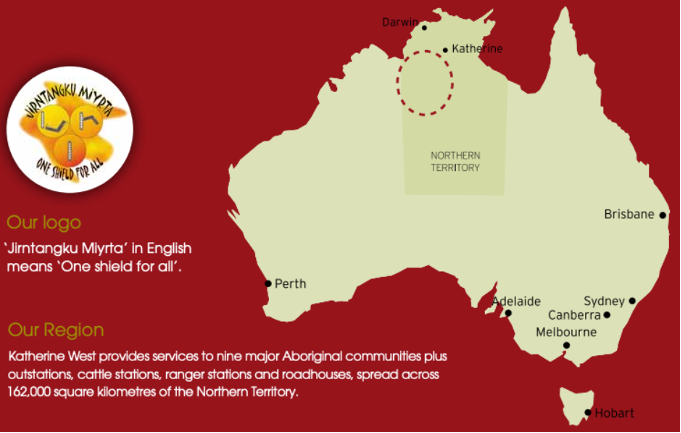
The Ngumbin* Reference Group (now the Culture and Leadership Advisory Group) is a consultative group of vastly experienced Board Members, Aboriginal Health Practitioners and retired Aboriginal Health Workers from the eight communities in the Katherine West Region.
If I was stuck out bush, these are the people I’d want with me. - David Lines Director Community Engagement.
CAPTION:
The NRG provides input and guidance about all health promotion materials and strategies for cultural appropriateness to ensure they are understandable to Ngumbin, effective in a remote community context and consistent with community priorities and preferences.
Ngumbin refers to a small Aboriginal language group in the region. It also is used for Aboriginal people in the region. Similar to use of Koori, Nunga, Noongar or Murri.
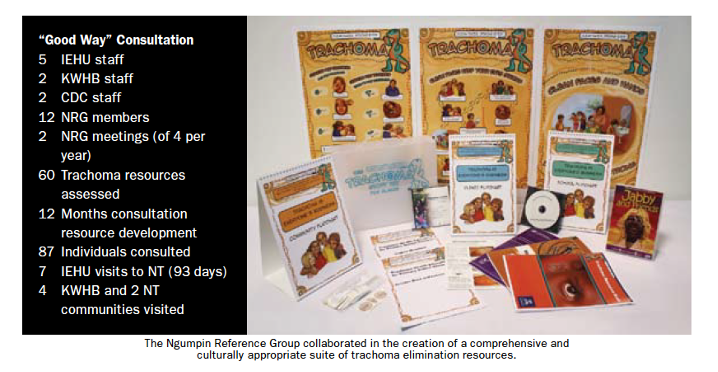
Meg Torpey and Joobin Hooshmand at IEH assessed over 70 trachoma resources including Australian and International literature for quality and content. Then over a 12-month period, the twelve-member Ngumbin Reference Group worked closely with IEH and CDC to check for cultural appropriateness of materials and their usability in remote Australian settings. The NRG did not want real life/photography or cartoon drawings of people as illustrations, but something in between and they liked the friendly goanna drawing used earlier in eye health resources for children. The goanna artist Lily MacDonnell was engaged to develop realistic illustrations for the resources.
The text and illustrations were compiled and carefully reviewed, and the NRG gave direct instructions: “the resources have to have clear and consistent drawings and messages” “tell us exactly how trachoma is caused and how we can stop it”.
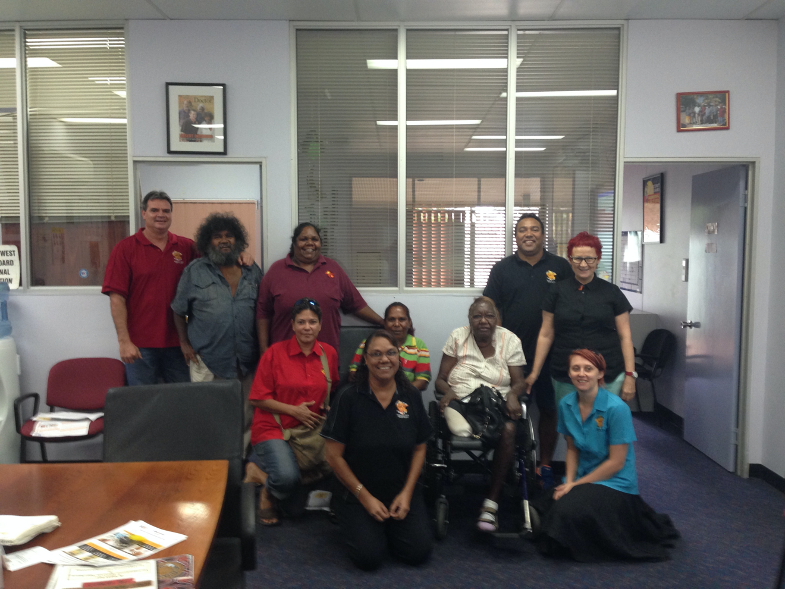
Image: L-R Back: David Lines (DL), Joseph Cox (dec), Deborah Jones, Brian Pedwell (BP). L-R Middle: Dee Hampton, Jocelyn Victor, Helen Morris (dec), Fiona Lange. L-R Front: Lynette Johns, Rebecca Cooney.
We spent months working on the kits, we would look at them at the board table, go away and think about them and then come back and look again. There were many emails, and this was a good way to help the Health Workers give feedback when working remote. – NRG Member
There is a picture in the kits of a kid having their eye lids flipped. In the first picture that we look at they were using a stick, to us that was going to encourage the kids to go and put sticks in their eye, so we suggested it needed to be a cotton tip. The Professor did not think that it should be changed, however as a group we felt strongly that it should, so we stood our ground on this. – NRG Member
The NRG named the resource the Trachoma Story Kit which combined easy to read, user friendly language incorporating clinical know-how, cultural knowledge and practices with friendly, realistic images of remote Aboriginal communities.
REF Baunach E, Lines D, Pedwell B, Lange FD, Cooney R and Taylor HR. "The Development of Culturally Safe and Relevant Health Promotion Resources for Effective Trachoma Elimination in Remote Aboriginal Communities. Aboriginal & Islander Health Worker Journal. 2012; 36(2): 9–16.
The kit is really good because it actually shows you how they get trachoma and what happens and how you can prevent it. It’s all about education, screening, treatment and the importance of follow-up. If you don’t follow up with the hygiene, well, you may as well be flogging a dead horse. - Rhonda Henry Aboriginal Health Worker 2012
Lunch and roll out of Trachoma Story Kits at KWHB September 2010

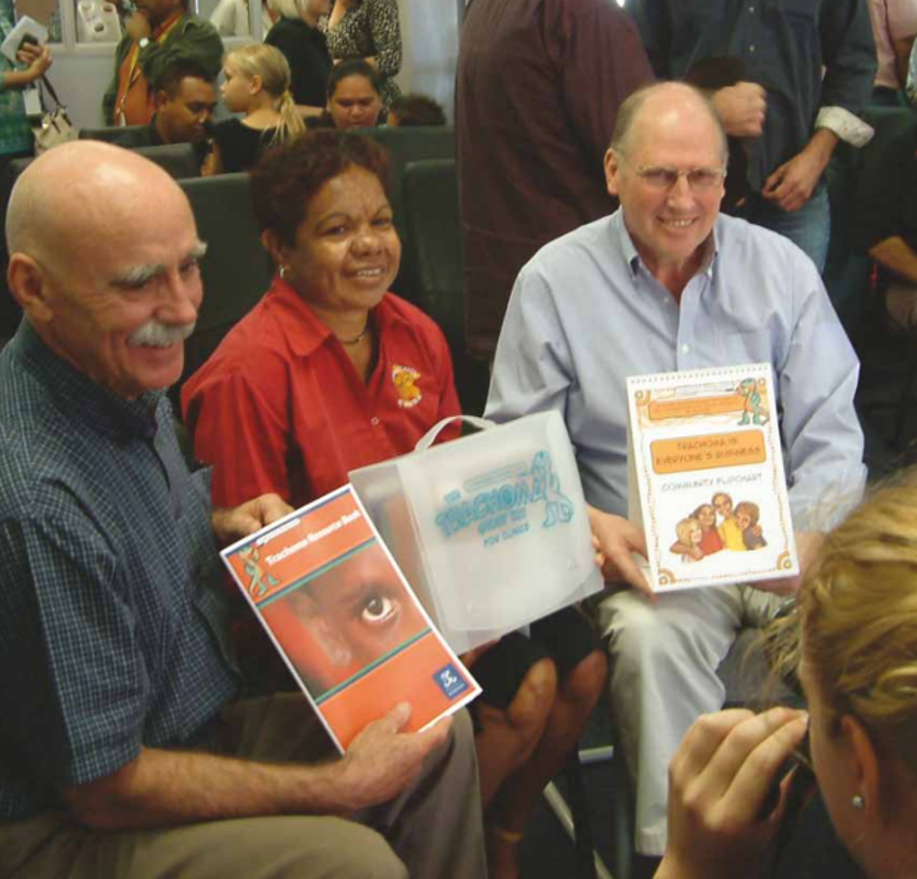
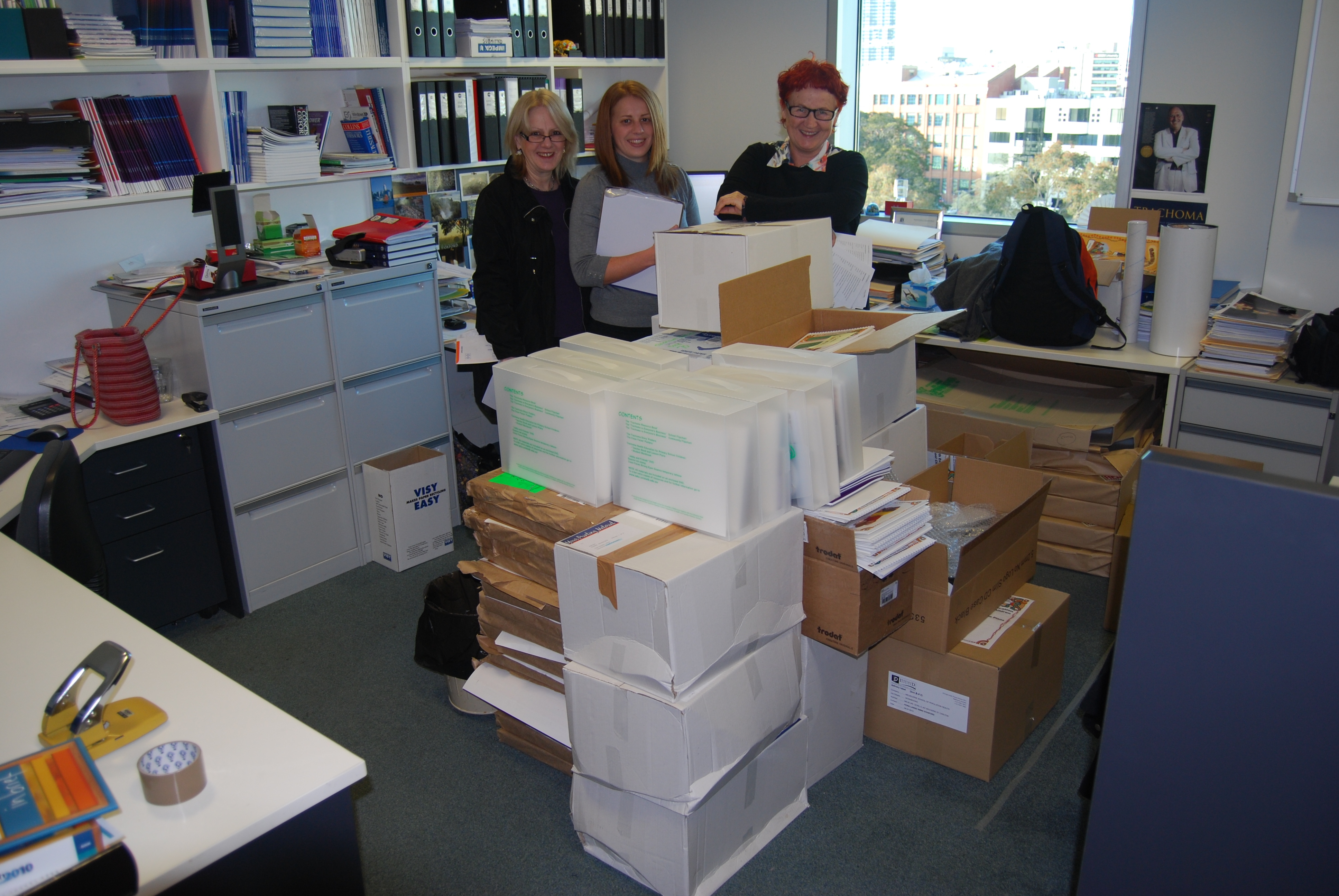
CAPTIONS:
In the early days the Trachoma Story Kits were funded solely by generous donors and assembled and packed in the office and basement at IEH by Rachael Ferguson, Fiona Lange and optometry students.
The remote trachoma programs paid only freight charges, which was a huge expense in very remote regions. The materials were taken up with enthusiasm and used by programs in trachoma endemic regions. After persistent advocacy by Hugh Taylor, Emma Stanford, IEH Board members and many other program supporters, the Australian Department of Health and Ageing endorsed the Kits as Australia’s main health promotion resource. DoHA fully funded the TSK and extra materials including the cost of freight to trachoma programs across the country and will continue until trachoma is finally eliminated.
The roll out to clinics, schools and communities incorporated staff training and pre/post evaluation across NT by CDC and support by IEH Cate Coffey, Heather Wilson, Carleigh Cowling, Fiona Lange.
Back at KWHB the kits were taken up with enthusiasm by champions Emma Baunach trachoma nurse and retired Health Worker and Ringer the renowned Mr Jack Little from Bulla, who worked tirelessly to educate children about trachoma and keeping their faces clean. Jack was clear and consistent, he told children in both English and local language exactly what they had to do to stop trachoma.
 CAPTION:
Jack Little was first recruited as an Aboriginal Health Worker by the out legendary Dr John Hargreaves, In turn, Jack became one of the true legends of Aboriginal primary health care in the Northern Territory. He was a key health leader in the establishment of the Katherine West Health Board late last century.
https://healthinfonet.ecu.edu.au/about/news/438/
The Bulla Clinic bears his name and Jack went on to be a patron for the Year of the Aboriginal Health Worker in the NT.
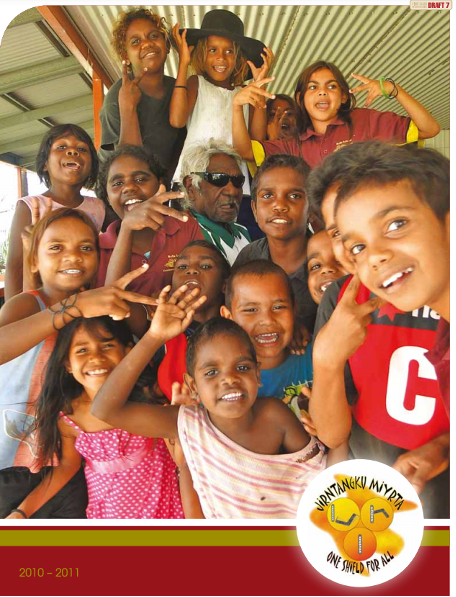
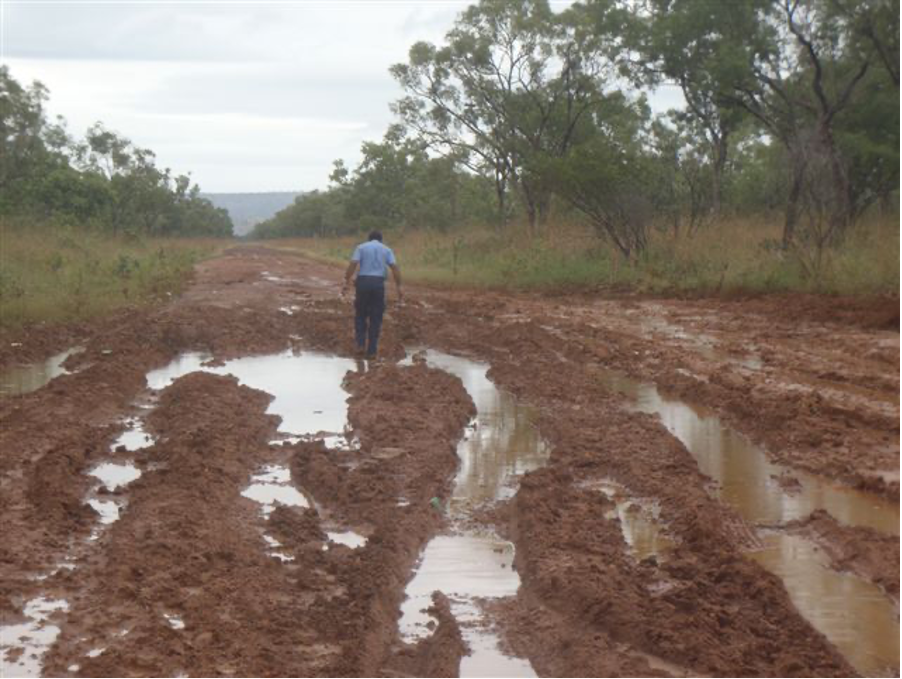 Image: Katherine region roads in the wet, one of the ongoing barriers to trachoma elimination.
(LINK - Fiona can you provide the link please) Link to YouTube video the Trachoma Story Kit, featuring Emma Baunach Healthy Skin and Eyes Coordinator and retired Aboriginal Health Worker and founding Board Member of KWHB and Aboriginal Health Worker Rhonda Henry
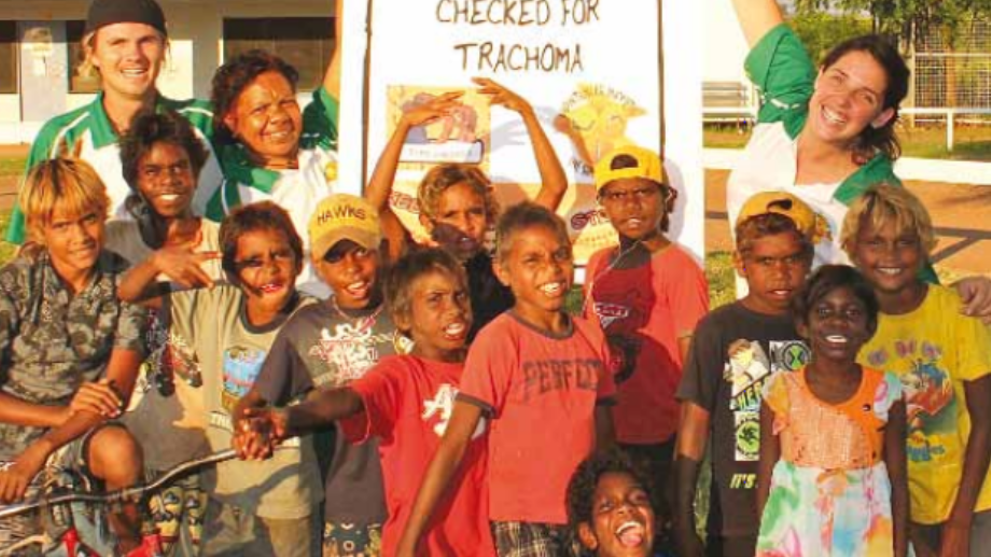 Image: Katherine West made dozens of adaptations of the TSK and there was never a lack of positive energy in the KWHB trachoma health promotion program
Clean Face, Strong Eyes (Kalkaringi Mob) 2012, was the first of many hip hop trachoma community videos made by Indigenous Hip Hop Projects (IHHP)
Where we are now NICK
2020 IEH adaptations, diverse resources, language versions, illustrations, mulitmedia, TV Radio 14 Milpas! Melb Football Club, Six Steps + Covid, Safe Bathrooms, advocacy housing en health, rolled out more widely in schools NT, TV ad by PHAIWA
2020
Use RAHC trachoma nurses sceening and treatment, continuity outsourcing, Healthy Harold program hygiene and wellbeing, use Social Media, Rotary interactive water trailer. Milpa costume,
Jack has retired, DL Head Community Engagement, reporting back posters, Ngumbin Reference Group now CLAG, trachoma still a problem in region,
Spread of resources RACHAEL
Since 2010 IEH have produced 1,800 Trachoma Story Kits, and over 13,000 additional resources have been ordered online.
You can order a TSK and additional resources for free here
If you have any questions relating to this ‘story’ please contact Fiona Lange, Translation Research Scholar Health Promotion, Indigenous Eye Health via email: flange@unimelb.edu.au
This 'Share your Story' article was published 18 December 2020.