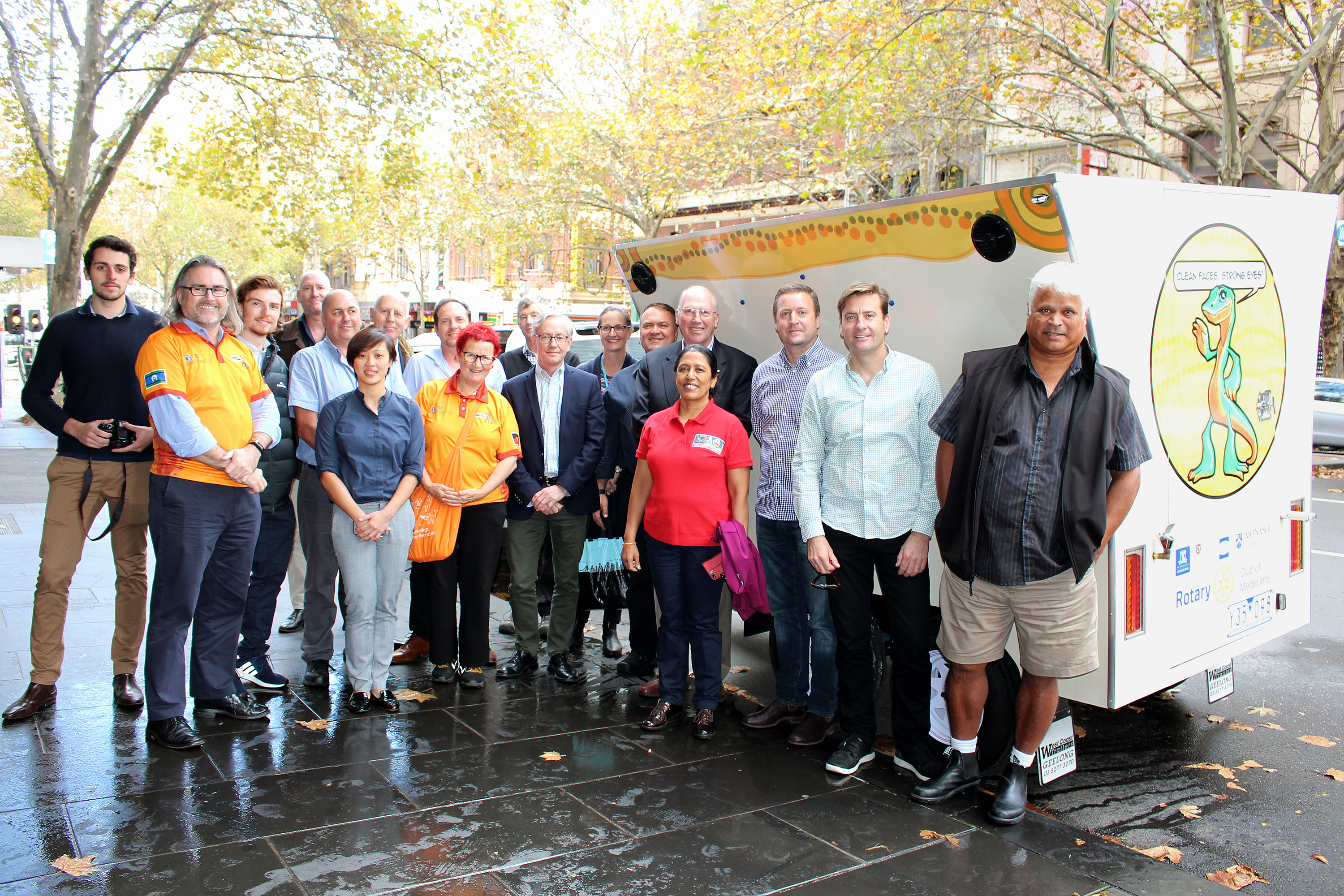
The Trachoma Face Washing Trailer prototype
The Rotary Club of Melbourne approached Indigenous Eye Health at the University of Melbourne in 2015 to seek practical ways the Club could offer support towards the elimination of trachoma in Australia by 2020 to coincide with the Centenary Year of Rotary in 2021.
A common problem in providing trachoma and hygiene health promotion is limited access to inexpensive hygiene supplies in remote Aboriginal communities such as mirrors, soap, towels and other hygiene consumables. Many communities don’t have public amenities such as toilets, showers, community laundries or wash stations outside stores. Some communities with swimming pools have problems keeping the pools staffed and open. Another difficulty when conducting hygiene education stations at trachoma footy clinics, health promotion activities and community education events, is limited access to water and wash areas in remote Indigenous communities.
In 2016 Rotary brought together technical experts, Monash University Industry Team Initiative candidates from the Faculty of Engineering & Faculty of IT, Telstra and IEH to create and design portable (or fixed) wash stations and to build a model for a prototype to support community trachoma education. The Trachoma Face Washing Trailer prototype will be used for trachoma health promotion and face and hand washing at community events in the remote Anangu Pitjantjatjara Yankunytjatjara (APY Lands).
The trachoma programs in the APY Lands in South Australia will use the trailer in 8 remote communities. The large bright trailer with Milpa the Trachoma Goanna and interactive games will provide fun and encourage play while face washing. The other taps and drinking fountain can be used for hand washing and drinking water, reinforcing hygiene educations messages from clinics, schools and communities.
The trailer will help with face washing to eliminate trachoma by 2020. It will also reinforce hygiene practices that can help reduce other hygiene related health conditions such as otitis media, gastro enteritis, respiratory infections, rheumatic heart disease, kidney disease – all which are common in remote Indigenous communities.
Keep an eye out for the Trachoma Face Washing Trailer prototype in the APY Lands!