Trachoma is the world’s leading infectious cause of blindness. It affects people living in remote and rural communities with inadequate sanitation and poor personal and community hygiene. The bacteria Chlamydia trachomatis causes inflammation and swelling under the inner eyelid leading to scarring. The scars cause eyelashes to turn inward and scratch the eye, producing intense pain made worse by blinking. Eventually, the scratched cornea becomes cloudy leading to irreversible blindness.(1)
In 2016 an estimated 200 million people are at risk of trachoma in 42 countries mainly in Sub-Saharan African countries like Ethiopia where 75 million people are at risk but also Afghanistan, India, Brazil, Colombia and some Pacific Island nations. Low-income countries like Oman, Morocco, Ghana, Gambia, Iran, Mexico, Nepal, China, Cambodia and Laos have eliminated trachoma in the last 10 years while Australia remains the only high income country to still have trachoma.(2)
Trachoma disappeared from mainstream Australia over one hundred years ago when improved hygiene facilities, water infrastructure and living conditions were introduced. Trachoma persists in the remote Aboriginal communities due to lack of safe, washing facilities in notoriously poor and chronically overcrowded housing infrastructure and poor hygiene. Young children with constant eye and nose secretions in remote endemic communities sometimes go unnoticed and washing a child’s face whenever its dirty is not always common.(3)
(3) Taylor HR (2008). Trachoma: A Blinding Scourge from the Bronze Age to the Twenty-first Century. Melbourne, Centre for Eye Research Australia
How is Trachoma Spread?
The infection is passed from one child to another when they have infected eye and nose secretions (dirty faces) which easily spread. Unlike other infectious diseases, for trachoma a single episode of infection is often not uncomfortable or noticed as being different. The problem is that repeated infections keep the inflammation present. The longer the inflammation goes on the more discomfort and severe the scarring, and the more severe the scarring the greater the risk of blindness.
A child easily may have between 30-40 episodes of reinfection during childhood and they may have had 160-180 infections to have scarring severe enough to cause blindness in later life(4). Each episode of infection may last a few months, but repeated reinfection leads to the appearance of continuing infection and disease.
(4) Gambhir M, Basanez MG, Burton MJ, Solomon AW, Bailey RL, Holland MJ, et al. The development of an age-structured model for trachoma transmission dynamics, pathogenesis and control. PLoS Negl Trop Dis. 2009;3(6):e462 doi: 10.1371/journal.pntd.0000462 [PMC free article] [PubMed]
How is Trachoma Eliminated?
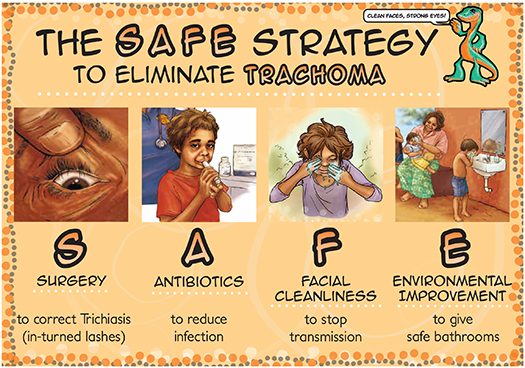
The World Health Organization developed the SAFE strategy to eliminate trachoma; Surgery to correct the in-turned eye lashes that rub on the eye and lead to blindness, Antibiotics to reduce level of infection, promotion of Facial Cleanliness to stop transmission, and Environmental Improvements in water and sanitation for supporting good hygiene.
The antibiotic treatment, Azithromycin, is making definite progress. It is given every 6 to 12 months to all household members or everybody in the community. This brings down the level of infection, but without stopping the possibility of transmission, trachoma will bounce back and this is why keeping every child’s face clean is so important. The essential and sustainable strategy comes back to clean faces, and having safe and functional bathrooms and washing facilities. Improved hygiene will also help to reduce other common, but very serious infections in remote Indigenous communities.
How Does Trachoma Health Promotion Help?
Health promotion activities play a very important role in stopping transmission of trachoma by promoting “Clean Faces, Strong Eyes”. Initially supported entirely by private donations and philanthropy, the Indigenous Eye Health group at the University of Melbourne worked closely with community groups to develop a suite of health promotion materials. This work is now also receiving Commonwealth support. The materials include posters, flip charts, and radio and tv ads. Milpa the trachoma goanna mascot features in the materials and is involved in the community activities such as the development of music videos, roadshows and football clinics.
How is Trachoma Elimination Progressing?
In 2009 the Australian government committed to eliminate trachoma by the year 2020. At that time the rates were poorly established and ranged between 15 and 20%. The data from 2015 show a massive change with the national average for children in the endemic areas to be 4.6%. Of equal importance is the dramatic reduction in the number of communities with trachoma. Now more than 150 of the 200 or so at-risk communities no longer have trachoma and there are only a small number of communities with high rates, the “hotspots”. These are mainly in and around Central Australia.
So we are making a big impact. However, we need to keep the pressure on until trachoma has gone for all the communities and we need to make sure good levels of facial cleanliness are maintained to stop it bouncing back.
test 1- About The Trachoma Story Kit
The Trachoma Story Kit
In 2012 we reviewed and refreshed the Trachoma Story Kit for Schools, Communities and Clinics by combining all three Kits into one new Kit, creating a ‘One-Stop-Shop’ for all settings.
With assistance from The Australian Government Department of Health and Ageing, we are now able to supply the Trachoma Story Kit at no cost.
We have updated many of the resources and even have some brand new items such as the A2 Community Flipchart, USBs, and DVDs available to order.
Trachoma Story Kit Content
These items listed are all included in the Trachoma Story Kit (which is available to order, or you can download many of the items individually).
The ‘Trachoma is Everyone’s Business’ School Flipchart (available for download)
The ‘Trachoma is Everyone’s Business’ Community Flipchart (available for download)
The ‘Trachoma is Everyone’s Business’ Clinic Flipchart (available for download)
The ‘Trachoma Resource Book’ (available for download)
Guidelines for Management of Trachoma in Australia CDNA (available for download)
Correcting 10 Myths about Eliminating Trachoma (available for download)
Key Messages for Trachoma Prevention (available for download)
World Health Organization Trachoma Grading Card (available for download)
Trachoma Health Education for Primary School Children: Teacher Book & Lesson Plans NT, SA & WA (available for download)
Trachoma Health Education for Primary School Children: Student Workbook(available for download)
The Trachoma Story Kit Poster Series: Clinic Poster, Story Poster & Clean Faces Poster (available for download)
'Clean Faces, Strong Eyes’ Milpa the Goanna Temporary Tattoos (available to order)
'Clean Faces, Strong Eyes’ Milpa the Goanna Ink Stamp
Children's Chatterbox
“Jabby and Friends” DVD
Trachoma Story Kit Development
The Trachoma Story Kit was launched in August 2010 and since then, more than 850 Kits have been distributed and used in a concerted effort to eliminate trachoma in Australia. Kits are used in clinics, schools and community workplaces in the Northern Territory, South Australia, Western Australia, Queensland and New South Wales to provide clear and consistent messages about trachoma, how it is spread and how everyone can help to eliminate it.
History of the Goanna
In 2008, graphic designer Lily McDonnell was approached by Center for Eye Research Australia (CERA) to create a mascot character to help promote healthy eyes to children in the Northern Territory. What resulted was a cheery-eyed, green and orange goanna which went to the optometrist and washed its face everyday.
Following the overwhelming popularity of the goanna’s healthy eyes promotional materials, in 2009 Indigenous Eye Health (IEH) at The University of Melbourne organised for the use of the goanna logo to endorse their Trachoma educational campaign.
Lily was then commissioned to rework the design to appeal to the community as whole and the “Children’s Eye Health” goanna became the “Trachoma” goanna. The resulting “Trachoma Story Kits” have become widely used in schools, clinics and many communities as an educational resource.
Now known as Milpa the Goanna, it has become a mascot for healthy eyes and good health across the Northern Territory.
To preserve the future integrity of Milpa the Trachoma Goanna and all the organisations associated with its projects we must retain artistic control over its use. Other organisations are able to use the Goanna logo and its associated materials and Style guidelines are available to maintain its visual presentation and re-enforcing its brand recognition and messages if used by other agencies.
IEH requests that organisations that want to use the Goanna logo seek permission to use and adhere to the associated style guidelines.
Acknowledgements
The Trachoma Story Kit was developed by a collaboration of Indigenous Eye Health, the Ngumpin Reference Group at Katherine West Health Board and the Centre for Disease Control Department of Health NT. By bringing together Aboriginal experts and clinical stakeholders the resources incorporate clinical knowhow with culturally acceptable, user friendly language and realistic images of contemporary Indigenous communities.
IEH has received generous support from; The Harold Mitchell Foundation, The Ian Potter Foundation, BB & A Miller Foundation, CBM Australia, The Cybec Foundation, The Aspen Foundation, "K" Line Logistics, Mr Greg Poche AO, Assoc Prof David Middleton, Mr Peter Anastasiou, Mr Rob Bowen, Dr Vera Bowen, Mr Noel Andresen and Dr Mark & Alla Medownick. Their ongoing support and encouragement allows us to work on 'Closing the Gap' for Indigenous Eye Health.
IEH and The University of Melbourne also receive funding from the Australian Government Department of Health.
Illustrations are by Lily McDonnell and the Goanna is used with permission of the Centre for Eye Research Australia.
test 2- Trachoma Resources
The following trachoma resources can be downloaded for use.
'Clean Faces, Strong Eyes’ Milpa the Goanna Ink Stamp
Children's Chatterbox
“Jabby and Friends” DVD
Trachoma Story Kit- Items for Download
Flipcharts
Trachoma is Everyone's Business - Clinic Flipchart is for Aboriginal Health Workers, nurses, doctors and other clinic staff. It can be used in two ways; as a source of trachoma information and training in trachoma control activities for staff, and as an education tool to talk about trachoma with patients. This flipchart has current key information about screening and treatment for trachoma and trichiasis, CDNA treatment guidelines and an azithromycin weight and height dosage chart.
Trachoma is Everyone's Business - School Flipchart presents a simple overview of trachoma for children in years 4-6 in primary school. It covers 'What is trachoma?', 'How do you get it?', 'Where is it found?' and 'What can be done to prevent trachoma?' This Flipchart is designed to be used along with the Teacher Handbook, Student Activity Book and the Jabby and friends DVD. There are also discussion questions for secondary school students.
Trachoma is Everyone's Business - Community Flipchart is for anyone who lives and/or works in a remote Aboriginal community and wants to know more about trachoma and how to prevent it. Many people may wish to take a role in trachoma prevention including; Elders, Aboriginal Health Workers, Aboriginal and Torres Strait Islander Outreach Workers, Aboriginal Community Workers, mums and bubs programs, environmental health workers, child care centre staff, sports and recreation officers, aged care facility staff and all other people who want to know about trachoma. This Flipchart will assist communities understand the basics of trachoma and how to eliminate it, covering; 'What is Trachoma?', 'How do you get it?', 'Where is it found?' and 'What can be done by individuals and communities to prevent trachoma?' The importance of screening for trichiasis and its treatment is discussed.
School Resources
Text Text Text.
The Trachoma Health Education for Primary School Children - Teacher Book and Lesson Plans and accompanying Student Workbook are resources developed for teachers in primary schools across the Northern Territory where trachoma remains a health issue. This Northern Territory Curriculum Framework is the basis of this health education program that will engage and educate primary school children about the importance of face washing and good personal hygiene for preventing trachoma and improving health and wellbeing. The six step-by-step lesson plans are highly interactive, and teach students how to assess their own health and take action for healthy living. Students discover many ways to protect themselves against trachoma and how to prevent its spread.
The Trachoma Health Education for Primary School Children - Student Workbook is used in Lesson One, Two, Three and Four, and additional resources when required are listed under each lesson. Students discover what they can use their eyes for, what is trachoma and how to how to protect themselves from it, who can help them to stay healthy and well, and self care skills to protect their eyes in their own familiar environment. The take home message is one of improving health and hygiene and that "Clean Faces = Strong Eyes". The Teacher Book and Lessons Plans and the Student Workbooks were developed by the Centre for Disease Control, Department of Health and Families Northern Territory, as part of a joint initiative between the centre for Disease Control, the Indigenous Eye Health Unit at the University of Melbourne and the Katherine West Health Board.
Teacher Book and Lesson Plans
Student Workbook
Trachoma Story Kit Posters
Text Text Text.
Clean Faces Poster
Trachoma Story Poster
Trachoma Clinic Poster
Additional Trachoma Resources for Download
Trachoma Cards
Text Text Text.
'4 Step' & Myths Card (A5)
'5 Step' & Hygiene Card (A5)
SAFE Strategy & Myths Card (A5)
3 T's & Myths Card (A6)
Melbourne Football Club Posters
Text Text Text.
MFC Player 'Action' Poster
MFC Player 'Hygiene' Poster
MFC Milpa & Checker Mascot Poster
Milpa & Yamba Posters
Text Text Text.
Milpa & Yamba Poster
test 3-Additional Trachoma Resources- For download