New ENEA flipchart supports eye checks in 715 Health Checks
A new flipchart resource from Minum Barreng: Indigenous Eye Health Unit, developed as part of the ‘Eyecare Now, Eyecare Always’ (ENEA) campaign,supports the delivery of eye checks in the 715 Health Check, helping to address preventable vision loss and blindness in First Nations communities.
Currently, around 30% (or more than 250,000) of Aboriginal and Torres Strait Islander people receive health checks each year. These health checks, including the MBS 715 Aboriginal and Torres Strait Islander Health Assessment (hereafter 715 Health Check), include a mandatory eye check and provide an important opportunity to detect eye health and vision issues early during routine primary care. This simple screening can help identify signs and symptoms of eye conditions that may otherwise go undetected or untreated. To help reduce the impact of vision problems, it is important to both increase the uptake of the 715 Health Check and ensure the eye check is consistently and correctly delivered as part of the health assessment.
National data indicates that many Aboriginal and Torres Strait Islander people continue to live with undiagnosed or untreated vision problems. Vision loss is experienced at three times the rate of non-Indigenous Australians, and it is estimated that more than 90% of this vision loss is preventable or treatable if picked up early.
The leading causes of these vision problems include:
- Refractive error - easily corrected with glasses, yet nearly one in five Aboriginal and Torres Strait Islander people with refractive error remain uncorrected, contributing to avoidable vision loss
- Cataract - requiring timely detection and surgery to
- Diabetic retinopathy - affects one in three Aboriginal and Torres Strait Islander people living with diabetes and requires regular monitoring to prevent progression to blindness. However, only 50% of those living with diabetes receive an eye check as part of their routine care
- Trichiasis from trachoma - remains an important condition to identify and refer for treatment in primary care
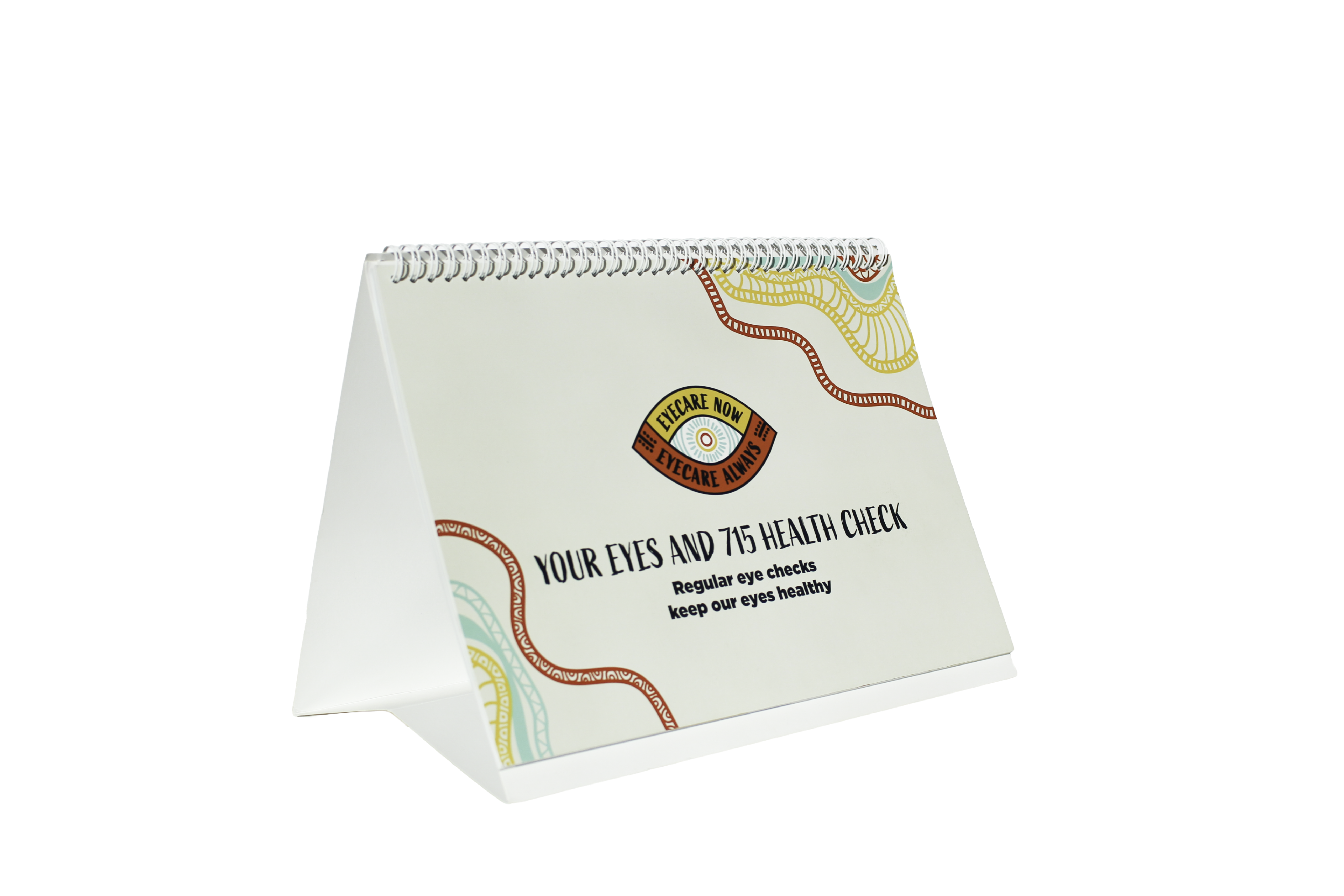
‘Your Eyes and 715 Health Check’ flipchart - a new patient education tool. View the flipchart
To help address this gap and support awareness amongst primary care providers and communities, Minum Barreng has developed a new health promotion flipchart, ‘Your Eyes and the 715 Health Check’, as part of the Eyecare Now, Eyecare Always campaign. This simple and visual tool is designed to remind Aboriginal Health Workers/Practitioners, nurses, doctors, health promotion staff, eye coordinators, and other primary care staff and community that a basic eye check is a critical and mandatory component of the 715 Health Check. Promoting the eye health component within the 715 Health Check can also support the use of retinal photography for people with diabetes (MBS item 12325). Used together, these two Medicare items help ensure that both general vision checks, and targeted retinal examinations are included in routine primary care.

Picture-based pages with text to make information easy to understand and support health literacy.
Developed in collaboration with community members and primary health care providers, the flipchart outlines what the eye check involves: asking about vision changes or eye problems, testing vision using a chart, examining the front and back of the eye, and referring for specialist care when needed. It also includes culturally appropriate images and plain language explanations of the main eye conditions.
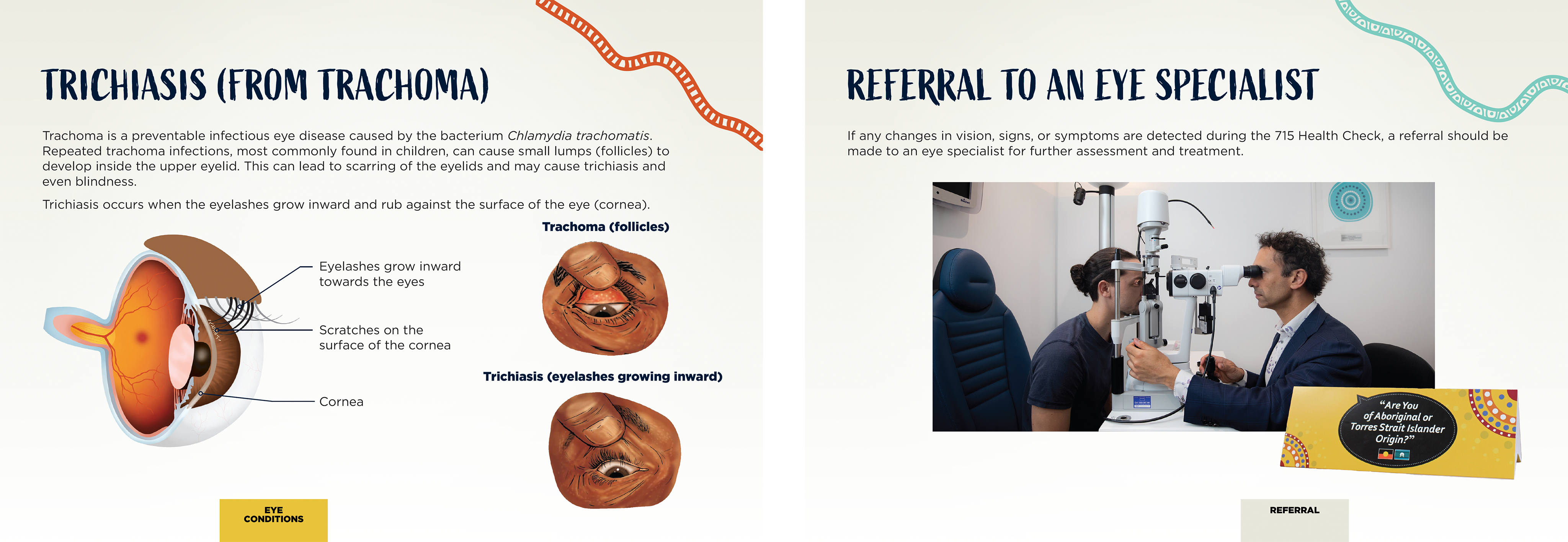
The ‘Your Eyes and 715 Health Check’ flipchart, its key messages, illustrations and images is designed to be flexible and can be used in a range of settings, including clinic consultations, staff training sessions, yarning circles, and community health promotion events. The flipchart supports both clinical reminders and patient education and aligning with the RACGP and NACCHO preventive health guidelines. It also complements other Minum Barreng national campaigns like 'Clean Faces, Strong Eyes‘ and ‘Check Today, See Tomorrow’.
Additional resources including posters, brochures and editable templates, will be available to support the flipchart. Like all Minum Barreng resources, these can be adapted to support place-based health promotion through local ownership and community uptake.
Early feedback has been really positive:
- I like that it outlines more than one eye health condition - Aboriginal Heath Practitioner, Northern Territory
- It is easy to look at and I feel whoever is delivering the information will learn a lot themselves - Nurse, Tasmania
- Easy to follow, colourful, lots of diagrams and graphics - ITC Coordinator, Victoria
- The way it’s all laid out makes it easy to show mob what we’re doing and what part of the eye were looking at and to get a better understanding why we do the eye health check and why it’s so important - Aboriginal Eye Coordinator and Nurse, Western Australia
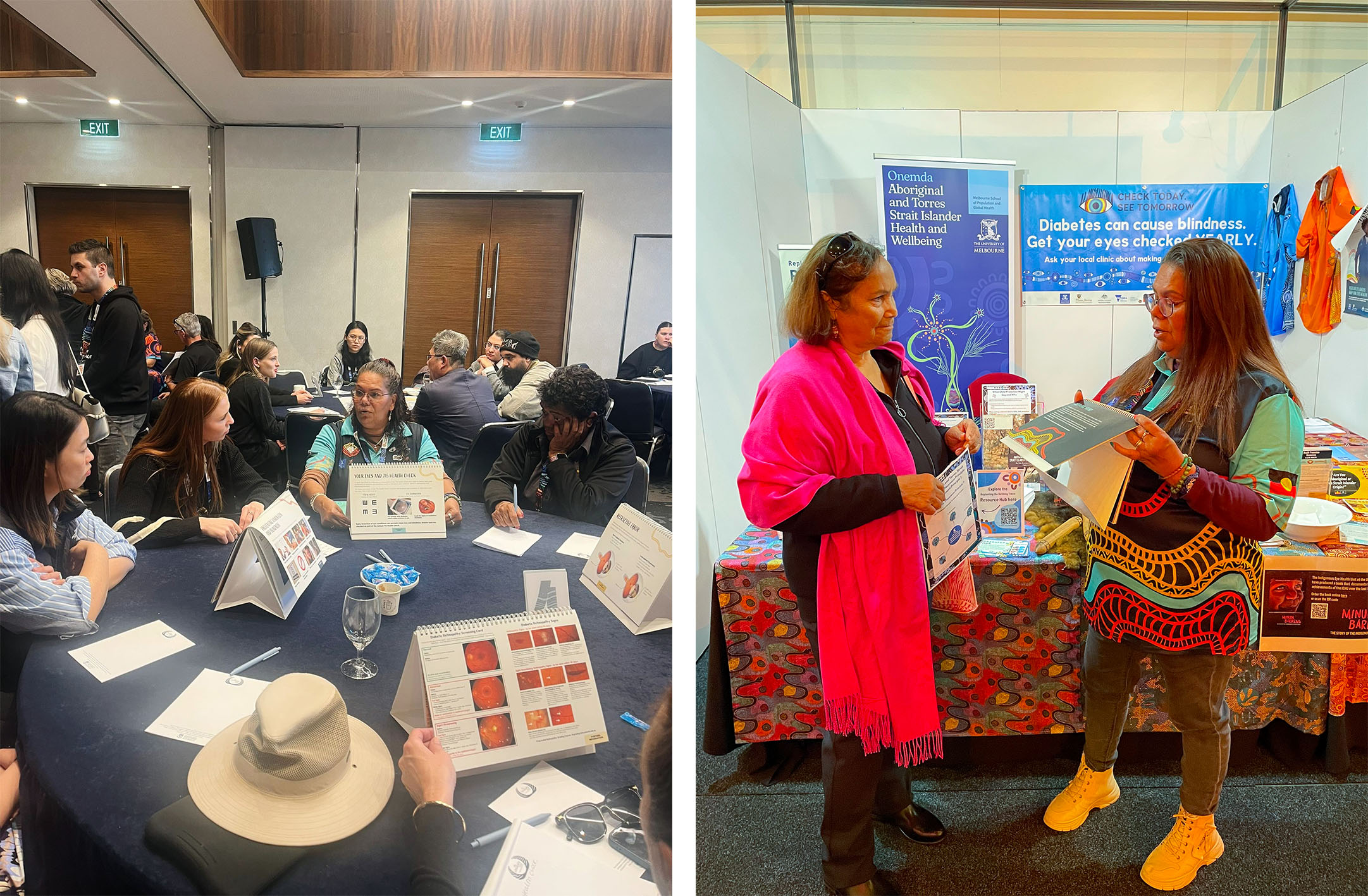
Lesley Martin sharing the draft flipchart at NATSIEHC25 in Perth and the Lowitja Conference in Adelaide.
A draft version of the flipchart was also presented by Lesley Martin, Minum Barreng’s Health Promotion and Community Engagement Officer, at the 2025 National Aboriginal and Torres Strait Islander Eye Health conference (NATSIEHC25) in Perth, with over 70 delegates attending her session.
- This is exactly what we need, something practical that reminds staff and makes the eye check feel like a normal part of the 715’ - NATSIEHC25 delegate
- ‘The visuals will really help open the conversation with patients. It’s simple and easy to use’ - NATSIEHC25 delegate
Further discussions at the recent Lowitja Institutes International Indigenous Health and Wellbeing Conference in Adelaide also helped inform and refine the final version of the flipchart, with sector delegates confirming the value of having a tool that prompts engagement and action.
Copies of the flipchart are now available to order for free via the ‘Order Resources’ section on the Minum Barreng health promotion webpage.
To learn more about ‘Eyecare Now, Eye Care Always’ campaign resources or to explore our other health promotion resources, visit Minum Barreng: Indigenous Eye Health Unit website.
For further information or questions, please contact the Minum Barreng: Indigenous Eye Health Unit at Indigenous-EyeHealth@unimelb.edu.au
Acknowledgements
We thank the many primary care providers, community members, and other health professionals who contributed their insights and expertise in the development of this new resource.
Artwork story:
‘TRAVERSING COUNTRY’ by Gilimbaa Executive David Williams (Wakka Wakka).
These elements represent the strength and vibrancy of First Nations people all over Australia. We are diverse and culturally strong peoples with humour to share and stories to tell. We are forever connected to Country, our families, and our communities.
Continuity of culture is one of the most important things for First Nations peoples. Our health and wellbeing is strengthened by these connections. The connections here are represented as a continual line from left to right; the line has no end.
As we walk on, feel, and see our Country, we are connected.
Useful Information and Resources
- NHMRC Guidelines for the management of diabetic retinopathy
- National Guide to a Preventive Health Assessment for Aboriginal and Torres Strait Islander people – NACCHO/RACGP (4th edition, 2024)
- Australian Indigenous HealthInfoNet – Eye health resources
- AIHW: Indigenous eye health measures 2024
- National Indigenous Eye Health Survey 2009 – Minum Barreng (Tracking Eyes) Full Report
- National Eye Health Survey 2016
- Department of Health, Aged Care and Disability Services – MBS Item 715 (Aboriginal and Torres Strait Islander Health Assessment)
- Mandatory Eye Checks – Minum Barreng Factsheet
- Department of Health, Aged Care and Disability Services – MBS Item 12325 (Retinal photography)
- Minum Barreng: Indigenous Eye Health Promotion Resources
- CARPA Standard Treatment Manual (8th edition, 2022)
- Clinical Procedures Manual for remote and rural practice (5th edition, 2022)