One Health comes to our shores
Australia is currently on high alert for outbreaks of influenza but they might not be what you think. Strains of the virus known as highly pathogenic avian influenza, or HPAI, caused several outbreaks on poultry farms in Victoria, New South Wales and the ACT this year, leading to the death and destruction of millions of birds. Fortunately, all of these outbreaks have been stopped, with the last stages of quarantine and post-eradication surveillance currently wrapping up at most sites.
These recent outbreaks involved strains of HPAI known as H7. However, since 2021 a strain known as H5N1 has spread across all parts of the world except Australia and New Zealand. It is a true panzootic, or global animal disease outbreak. It has caused the death of about 130 million domestic birds, massive mortality events in wild birds and sea mammals, and infected dairy farm workers and cattle in the USA. Historically, human H5N1 infection has had a high fatality rate although current human infections have fortunately only involved mild symptoms this year.
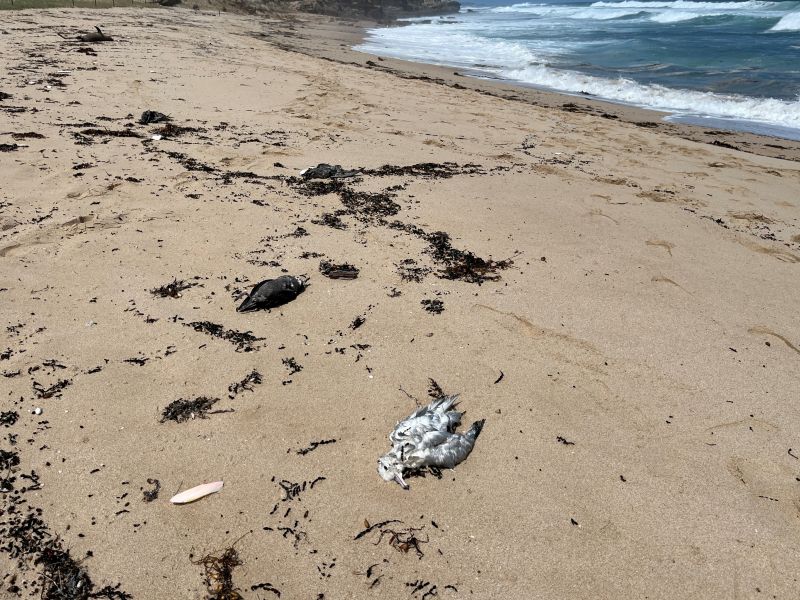
The weekend after I attended a recent HPAI update I was walking on the beach south of Melbourne. In a few hundred meters I counted over 40 dead shearwaters, a dead silver gull and, more worryingly, a dead Australian fur seal. I called the Australian Emergency Animal Diseases hotline (1800 675 888—the recommended action if you see an unusual wild bird disease event) and an Agriculture Victoria team visited the beach for sampling. All the birds they tested that day and this season to date were negative for HPAI. They suspect this is a shearwater ‘wreck’, or seasonal mortality event that occurs from time to time as these birds migrate the length of the Pacific Ocean back to Australia to breed in spring. It is unknown whether changed food availability due to climate change, severe weather events, marine pollution (plastic) or a different infection could be affecting the severity or frequency of these events.
So why am I writing about this in a global health newsletter? HPAI in poultry is a critical issue for households that depend on poultry for their livelihoods—for income from all kinds of farms around the world, plus as a critical protein source for millions of families. Families, especially women and children who are typical smallholder chicken farmers, suffer when their birds die of HPAI or are culled during control programs.
There have been (only) 47 HPAI emergence events globally since the 1960s. All but three have been eradicated soon after they occurred but the current H5N1 panzootic can be traced back to a strain that emerged in China in the 1990s that has since acquired the ability to spread more successfully within poultry and spill back to wild birds, which have spread it around the world.
Thus, the strength of veterinary services around the world is critically important for responding to and limiting these threats to public health and livelihoods. Furthermore, multiple public and private institutions must cooperate to ensure poultry farming does not encroach on wild bird habitats where the risk of spread between domestic and wild birds is greatest.
HPAI is a truly One Health issue that affects public health, livelihoods, wildlife and sustainable development. It requires more than a public health response, and must be tackled by addressing its root causes, including sustainable farming and development, biodiversity conservation, and strong public health, veterinary and environmental services.
Associate Professor Angus Campbell leads the One Health Unit at the Nossal Institute for Global Health. He is a livestock veterinarian and epidemiologist with over 20 years’ experience working in One Health, international agricultural development and livelihood security.