Miegunyah Distinguished Visiting Fellowship Public Lecture: Violence, harm, recovery and integration and gender-based violence.
Forced displacement is a global crisis. Over 100 million people were displaced as of the end of 2022 and with increased geopolitical instability and the impact of climate change, a huge increase in displacement is expected in the next decade. WHO estimates up to 700 million people will be forced to leave their homes by 20301.
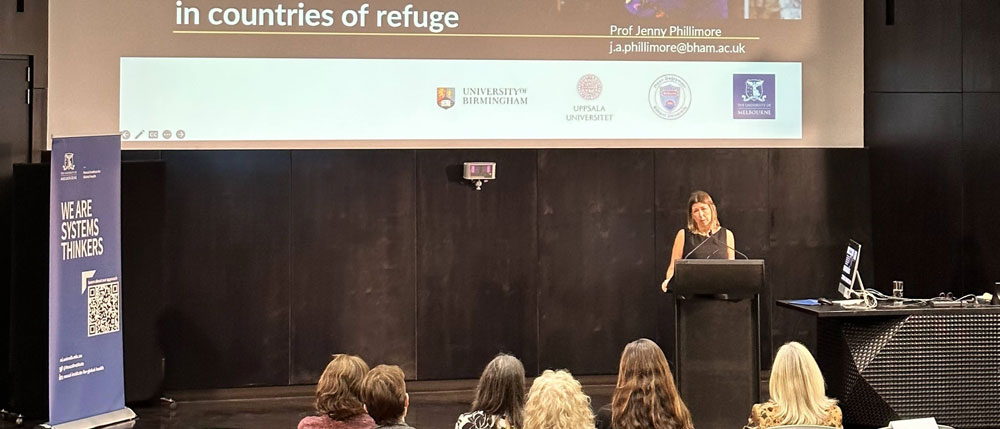
Professor Jenny Phillimore, an expert in Migration and Superdiversity at the University of Birmingham, researches refugee integration from the perspectives of refugees. Professor Phillimore was in Melbourne to deliver a public lecture on the extraordinary levels of sexual and gender-based violence (SGBV) experienced by refugees and the impact this has on their health and integration into countries of refuge. It is a difficult but critically necessary topic to explore and address by developing responses together.
The facts were brutal. There are millions of women, children, LGBTQIA+ people, and some men vulnerable to SGBV, which includes interpersonal and structural violence.
"It's messy and muddy" she said, as she shared the continuum of violence faced by refugees across time and place and at the hands of multiple perpetrators and the many barriers to accessing safety and support.
Despite the adversity faced, remarkable resilience was found from refugee survivors in the SEREDA (SGBV Against Refugees from Displacement to Arrival) project led by Professor Phillimore looking at forced migrants’ experiences of sexual and gender based violence. The kindness shown by strangers, support services and community had life-changing consequences and helped begin to restore people’s hope in humanity.
With forced migration on an upward trajectory, this is not a problem that can be ignored. We need urgent action now focusing on systemic changes to address the causes of forced displacement, to prevent violence and address impunity, and to provide adequate supports for refugee survivors.
We need to take responsibility and use the wealth we have generated. We need to support and resource those populations to put those climate mitigations in place. Professor Jenny Phillimore
Women and children are disproportionally impacted by forced migration. One of SEREDA’s key recommendations is to attach strings to future funding commitments. Organisations making global pledges must specify their funding tied to support of women and girls; and LGBTIQ+ people.
Professor Phillimore also encouraged those gathered to take their own micro-political actions: be kind, be accountable, learn and educate, challenge, volunteer and vote.
Missed the lecture? You can watch the full event online
Professor Phillimore was in Melbourne as a Miegunyah Distinguished Visiting Fellow. The fellowships are awarded annually and generously supported by The Russell and Mab Grimwade Miegunyah Fund. The program enables overseas scholars of international distinction to make an extended visit to the University Of Melbourne and contribute to the university’s academic, intellectual, and Cultural life. Professor Phillimore was hosted by Nossal Institute for Global Health and presentation supported by Melbourne School of Population and Global Health and the Melbourne Social Equity Institute.