Balancing Health and Sustainability: Why the Sector Must Act for a Just Energy Transition
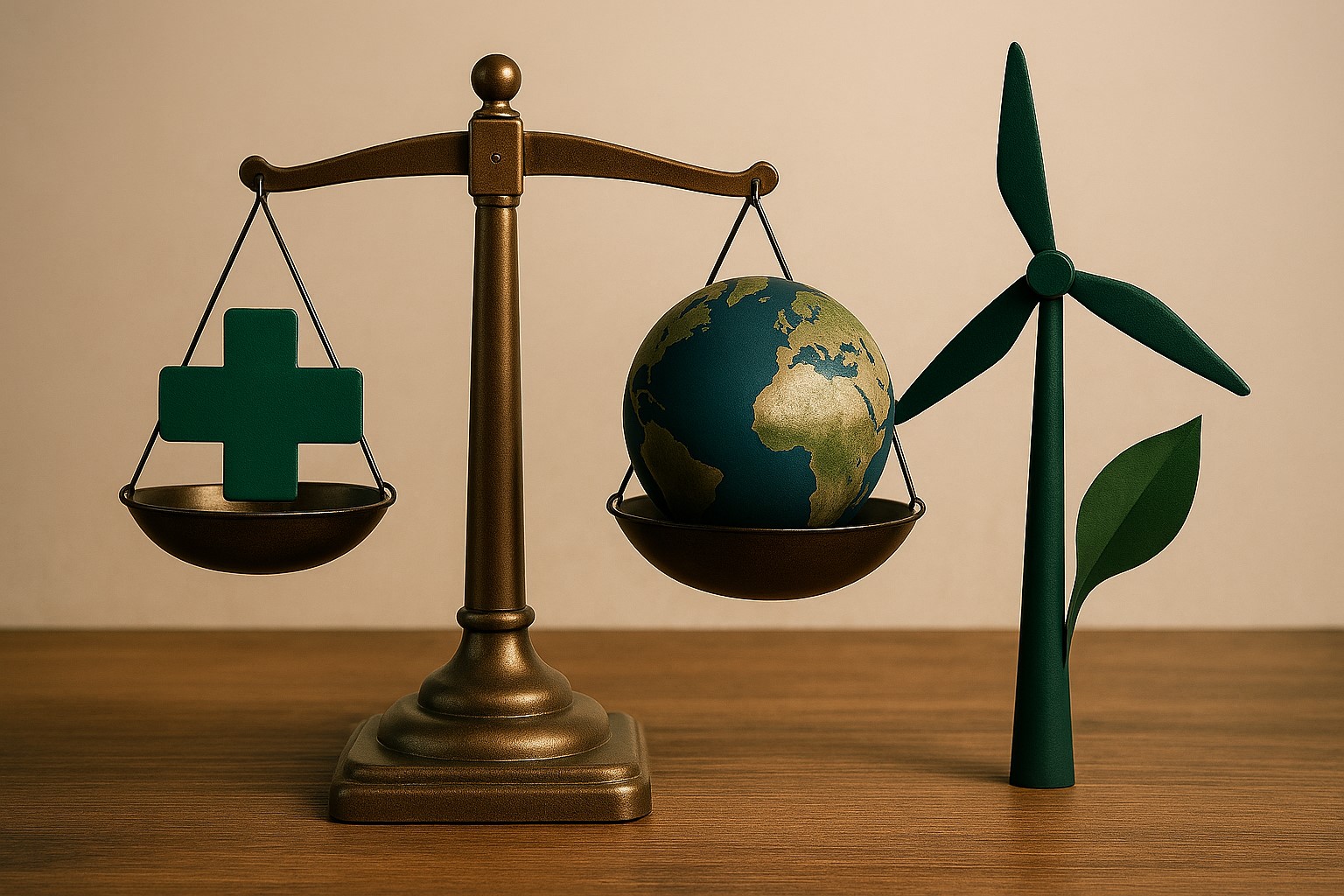
Climate change is a daily reality affecting the health and wellbeing of billions. From heatwaves and wildfires to floods and food insecurity, the impacts are intensifying. And while the health sector is on the frontlines of saving lives, it’s also contributing to the crisis. 1
Here’s the paradox: the health sector, built to protect life, also contributes to climate change. Globally, it’s responsible for 4–5% of greenhouse gas emissions. Hospitals run 24/7 on energy-intensive systems Pharmaceuticals consume more energy and water than the auto industry. Medicines and vaccines travel thousands of carbon-heavy miles. And the waste — plastics, PPE, single-use devices — is often incinerated, releasing toxins into the air. The Health Sector is saving lives today, while harming health tomorrow.
How do we balance sustainability, energy, and health? The World Energy Council’s “Energy Trilemma” — balancing energy equity, energy security, and sustainability — offers a useful framework. But we need to go further. The trilemma needs to be extended to reflect the growing intersection between energy, climate, and public health.
Including health equity in the framework requires action political will, policy and investment. The Nossal Institute has been working in partnership with the Asian Development Bank and other regional partners to develop the Just Energy Transition (JET) program. Over the past three years, we’ve spear headed a coordinated effort from governments, businesses, civil society, and other stakeholders to ensure that the shift towards a more sustainable and equitable future benefits everyone and leaves no one behind.
This is more than a technical challenge—it’s a social one. Our work integrates gender equality and social inclusion (GESI), ensuring that the transition benefits everyone, especially those most at risk. A just energy transition is a historic opportunity to advance Health equity, Environmental sustainability and Climate justice. We must pursue it with seriousness and commitment. The health sector can — and should — lead the way.
Dr Reihana (Sithy) Mohideen, a Principal Advisor at the Nossal Institute, is an electrical engineer with a strong interest in developing integrated socio-technical approaches to enable an inclusive transition.
1 https://www.who.int/news-room/fact-sheets/detail/climate-change-and-health