Disability-inclusive development: Reflections on 2030 Progress
Alex Robinson, Nossal Institute for Global Health, University of Melbourne.1
This ‘Disability equity and rights: Challenges, opportunities, and ways forward for inclusive development’ publication was prepared under the DFAT – CBM Inclusion Advisory Group Disability Inclusion Technical Partnership, an Australian aid initiative implemented by CBM Inclusion Advisory Group and the Nossal Institute for Global Health at the University of Melbourne.
This publication has been funded by the Australian Government through the Department of Foreign Affairs and Trade. The views expressed in this publication are the author's alone and are not necessarily the views of the Australian Government.
Introduction
In 2015, governments committed to end poverty in all its forms everywhere and to ensure no one is left behind. This aspiration drew a line under previous global development frameworks by specifically addressing the inclusion of people with disabilities. In contrast to preceding frameworks, disability inclusion was emphasised and endorsed in the 2030 Agenda and Sustainable Development Goals (SDGs), the Sendai Framework for Disaster Risk Reduction 2015 to 2030, and the Paris Climate Agreement. This brought contemporary global development frameworks in line with the United Nations Convention on the Rights of Persons with Disabilities (CRPD), 2006. We are now at the mid-point of the 2030 Agenda and Sendai Framework.
The 2023 United in Science report finds we are only on track to meet 15% of the SDGs by 2030 2. Limited progress has been compounded by lost development gains and rising inequality triggered by the COVID-19 pandemic. 3 The Mid-term Review of the Sendai Framework reports we will not meet risk reduction objectives agreed in 2015.4 We are also off-track to meet 2050 Paris Agreement targets to limit global warming to 2oC, and ideally 1.5oC, above pre-industrial levels.5 There is now a 66% likelihood that global temperatures will exceed 1.5oC, in at least one of the next 5 years.6 It is widely acknowledged that those most marginalised are most affected by these changes and our lack of progress. It is no longer simply enough to accelerate progress to achieve 2030 objectives: our efforts need to be ‘supercharged’.7
With limited progress towards global targets, people with disabilities face ongoing disadvantage and inequity. We can expect this to be exacerbated by the disproportionate impacts of climate change, increased disaster risk, and persistent poverty and marginalisation. The optimism that surrounded disability inclusion in 2015 has been severely dampened.
Looking ahead to 2030
We asked a group of experts to contribute essays on what they see as key challenges and opportunities for achieving disability inclusion by 2030. This included individuals with lived experience of disability. This introductory essay presents a high-level overview and readers with specific sectoral or thematic interests should refer to the individual essays.8 The essay topics and thematic areas covered are limited, non-exhaustive, and do not necessarily represent priority areas for all disability stakeholders. However, we are confident the essays address important contemporary issues in disability-inclusive development and provide a timely and important point of reflection.
While the authors recognise progress has been made, the essays are not written as a point of celebration. Commitments have been made, progress is expected, and the overarching concern is that much remains to be done and, for some, there is a growing sense of frustration. The essays call for increased prioritisation, resourcing, and comprehensive action toward disability inclusion – they urge us to take stock and start working differently.
Disability inclusion then and now
In 2012, CBM with contributions from the Nossal Institute, published Inclusion Made Easy: A Quick Program Guide to Disability in Development.9 The guide emphasised partnering with organisations of people with disabilities (OPDs) and applying a twin track approach. With the addition of collecting and using disability disaggregated data, these 3 principles have formed the mainstay of disability-inclusive development guidance and advisories over the last decade. While these principles hold true today, their adoption and application has been limited. Of deeper concern is that despite the wealth of guidance produced over the last decade, there remains limited evidence of positive impact on the lives of people with disabilities.
The objective of advocacy messaging in the run up to 2015 was to demystify disability and to counteract the view of many in global development that disability inclusion was overtly technical and complex. Non-technical solutions were needed to raise awareness, generate buy-in, and ensure disability inclusion in the 2015 frameworks. To this end, the advocacy was successful; however, we need to recalibrate and move the dial forward.
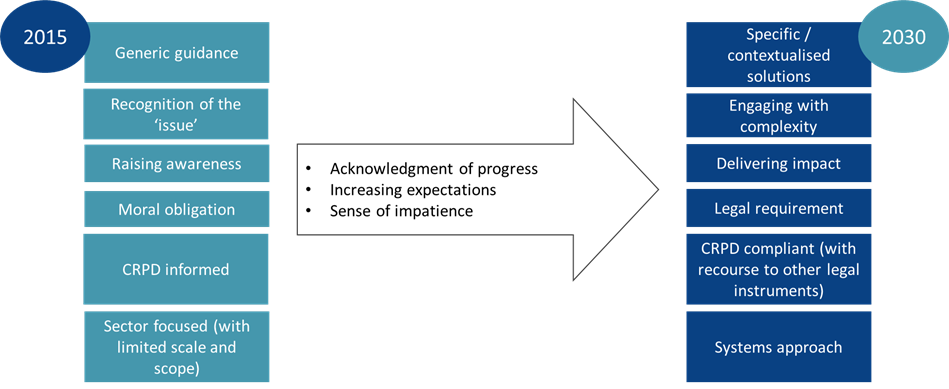
Figure 1. Evolving priorities for disability inclusion from 2015 to 2030
Sticky issues and working differently
Mainstreaming and disability specific interventions
In the run up to 2015, raising awareness of the importance of disability inclusion and recognition of the disadvantage that people with disabilities face was a significant achievement. However, the translation of this understanding into action has stalled. In practice, disability inclusion remains deprioritised, under-resourced, and typified by small-scale projects and investments of limited scale. The mainstreaming of disability inclusion in programs remains piecemeal with institutional responsibility outsourced to OPDs and disability-focused organisations. Or responsibility is deferred to an individual advising on social inclusion in its entirety. Relatedly, guidance on disability inclusion shows little progression. Standardised approaches are uncritically repurposed and applied across the spectrum of development programs and activities. While programs and sectors are becoming increasingly specialised, guidance on disability inclusion has remained generic.
Greater attention needs to be paid to integrating disability inclusion into programs and investments. This requires full recognition of the responsibility for mainstreaming held by program planners, managers, and implementers. However, if we are to leave no person with disabilities behind by 2030, this will not be enough. While increasing recognition of the need for mainstreaming is noteworthy, it has been at the expense of investment in disability-specific programs and interventions. We urgently need to recalibrate to ensure individuals with all levels of support needs, including high support needs, are accounted for, can participate, and are included. Including all people with disabilities requires acknowledgement that health-based interventions, including rehabilitation, assistive technology, and allied health services, are fully compatible with the Social Model of disability and rights-based approaches.
Equity as outcome
While there have been efforts to increase the participation of people with disabilities in programs and policies, these are not clearly resulting in equitable outcomes. This is, in part, due to siloed and sector-specific interventions. For example, equity in workforce participation between people with and without disabilities requires attention to inclusive education. Equity in education is, in turn, reliant on early identification of disability and access to inclusive early childhood development supports. These are complex issues with multiple influencing factors and illustrate the limitations of standalone interventions. To ensure equity, we need to better engage with complexity and apply a systems lens to challenge the constraints of traditional administrative and sectoral boundaries.
Equity will also not be achieved without addressing the underlying causes of exclusion for people with disabilities. Frustration with established approaches to disability inclusion and a lack of clear impact has driven the disability movement to reconfigure and reprioritise disability inclusion approaches with the objective of ensuring equity. This includes addressing ‘pre-conditions for inclusion’ as policy priorities for ensuring equitable participation in society. For the Pacific Disability Forum, these non-negotiable pre-conditions are accessibility, assistive devices, support services, social protection, non-discrimination, and community-based inclusive development.
Recent gender, disability, and social inclusion (GEDSI) approaches and the extent they are addressing intersectionalities are also a key equity concern. To date, GEDSI initiatives have been more reflective of a ‘gender plus’ approach. That is, a focus on gender with some reference to disability and possibly age. Rather than addressing intersectionalities across and between identity characteristics, approaches remain siloed within an overall GEDSI framework. There is also the risk that some groups, such as people with disabilities, and some thematic areas, such as gender-based violence, are relegated to the background. On the one hand, combining responsibilities under a single GEDSI umbrella is a response to resource limitations and could play a constructive convening role. However, current GEDSI approaches and roles are likely to be challenged by the need to incorporate tailored and more technical disability inclusion solutions within programs. In response, we need to consider: who needs to know what and why? While disability inclusion is ‘everyone’s business’, more nuanced consideration of what information is needed at different levels of decision-making and implementation would be helpful. Knowing where, and importantly how, to access expertise is key.
Issues of representation
An intersectional GEDSI lens can highlight diversity and the underrepresentation of specific groups of people with disabilities. At the same time, issues relating to representation persist. While not exhaustive, this includes charges of tokenism, ‘box ticking’, and insufficient attention to resourcing and power differentials levelled at development actors by OPDs. Some OPDs also acknowledge more needs to be done to ensure gender and age equality within their own work. Attention also needs to be paid to ensuring the voices of children and young people with disabilities are heard. This requires engaging with caregivers and directly with young people with disabilities themselves.
Caregivers and parents of children with disabilities are part of a wider disability and support ecosystem. There are two important considerations that relate to caregivers and representation. The first is the role that caregivers may play in representing children with disabilities and, in specific cases, facilitating supported decision-making by some adults with disabilities. It is noteworthy that children with disabilities and, for example, people with psychosocial disabilities are not well-represented by, or within, OPDs. Secondly, it is important that parents and caregivers have their own voice. Informal and unpaid care impacts on the economic security of households, the social participation of family members across generations, and the wellbeing of individuals with disabilities.
Justice and legal compliance
Inequity and violence against people with disabilities are persistent themes. This includes disproportionate exposure to specific forms of gender-based violence; physical restraint, institutionalisation, abuse, and neglect; stigma and prejudice; higher death rates in situations of risk and climate injustice; and persistent socio-economic disadvantage and exclusion. The CRPD has almost universal ratification by UN Member States, whether those countries are donors or recipient partners of development cooperation. The implication is that disability inclusion, and addressing inequity and violence, is now mandated under national law in most countries we work.
Members of the disability movement are increasingly turning to legal recourse whether that is under laws based on CRPD ratification or, where these are deemed insufficient, alternative legal instruments. For example, on torture in the case of rights abuses stemming from forced institutionalisation. A failure to acknowledge the gravity of CRPD ratification and the subsequent establishment and implications of national disability laws will increasingly expose implementing partners and investments to institutional, reputational, and financial risk.
Expectations and standards
At the global level, expectations have been set. That is, by 2030, we will leave no one behind. To ‘supercharge’ efforts, we need to rigorously translate this aspiration into development practice. A starting point is reconsidering equity as our principal objective. This will not be achieved by a reliance on accepted standards, inadequate resources, and current ways of working. We need to become comfortable with complexity, working across systems, and addressing the root causes of exclusion and injustice in our work. Towards this end, we hope these essays provide some points of reflection and inspiration.
Alex Robinson, Nossal Institute is head of the Institute’s Disability, Inclusion and Rehabilitation team. His work on disability, development and disaster risk focuses on the delivery of actionable and equitable policy and programming solutions.
References
[1] Nossal Institute for Global Health, University of Melbourne. Lead/corresponding author: Alex Robinson, alex.robinson@unimelb.edu.au Inputs from Laisa Vereti and Setareki Macanawai. Review by Fleur Smith, Kate Neely and Lucy Daniels.
[2] World Meteorological Organization. 2023. United in Science 2023. Sustainable Development Edition. https://library.wmo.int/records/item/68235-united-in-science-2023
[3] World Bank. 2021. Poverty, median incomes, and inequality in 2021: a diverging recovery. https://documents1.worldbank.org/curated/en/936001635880885713/pdf/Poverty-Median-Incomes-and-Inequality-in-2021-A-Diverging-Recovery.pdf
[4] United Nations General Assembly. 2023. Main findings and recommendations of the midterm review
of the implementation of the Sendai Framework for Disaster Risk Reduction 2015–2030
[5] World Meteorological Organization. 2023. United in Science 2023. Sustainable Development Edition. https://library.wmo.int/records/item/68235-united-in-science-2023
[6] Ibid
[7] Ibid
[8] Essay topics cover: Caregiving, deinstitutionalisation, digital technologies, disaster risk, early childhood development, elimination of violence against women and girls, inclusive education, organisations of people with disabilities, preconditions for inclusion, psychosocial disability, rehabilitation and assistive technology, and social protection.
[9] CBM. 2012. Inclusion Made Easy: A quick program guide to disability in development.
Explore other essays in this series
