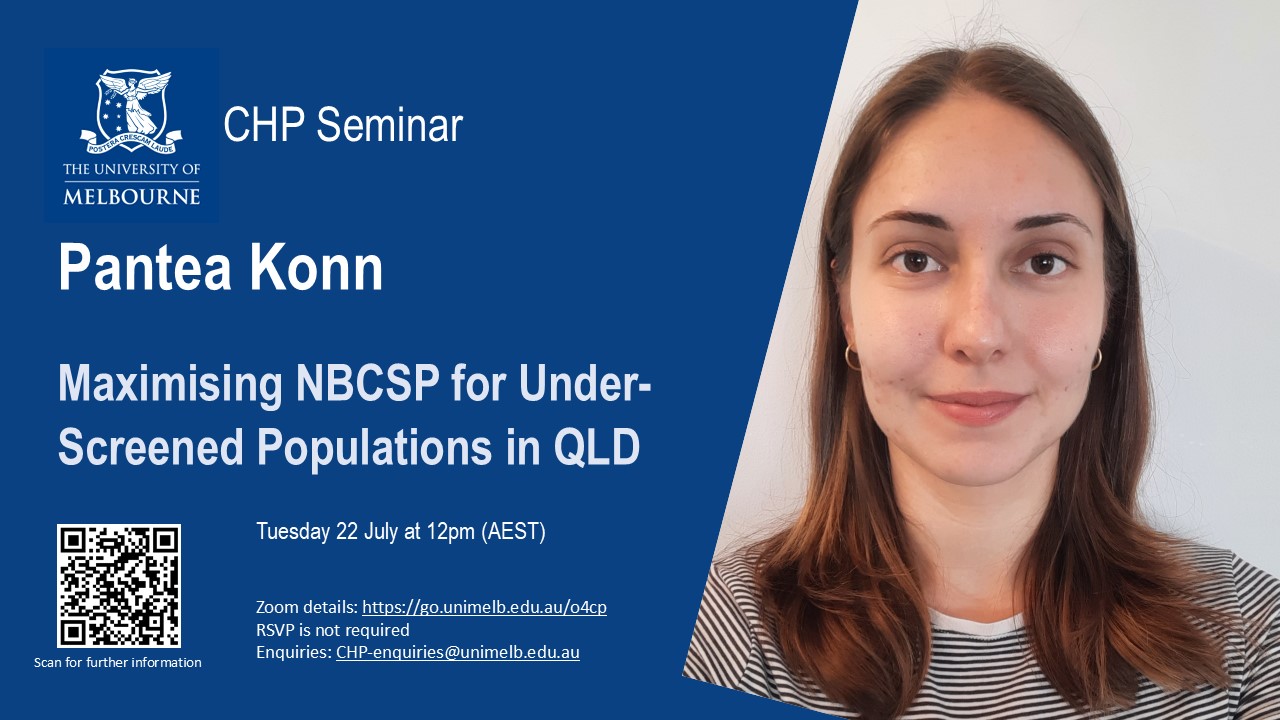
CHP Seminar - Pantea Konn
Share via
Title: Maximising NBCSP Recruitment for Under-Screened Populations in QLD
Bio: Pantea Konn is a senior data analyst with Queensland Health’s Cancer Screening Unit, where she generates analytical insights which inform strategies aimed at improving participation across several cancer screening programs. She holds a Bachelor of Mathematics from the University of Queensland and has a technical background in data engineering, statistical programming, and analysis. This expertise allows her to process and analyse large national datasets, including those provided by the National Cancer Screening Register, to support initiatives to enhance bowel cancer prevention and early detection across diverse populations.
Abstract: Bowel cancer is the second most diagnosed cancer in Australia. The National Bowel Cancer Screening Program (NBCSP) functions for early detection of the disease but has faced persistent challenges in recruiting participants, with a national participation rate of 41.7%. There are a high number of potential participants who never-screen or are under-screened, particularly in Queensland where 67% of previous screeners have missed their most recent screening round. Queensland Health’s pilot project explores whether targeted, low-cost SMS behavioural nudges can effectively increase recruitment and participation among these populations, addressing a critical gap in preventive health efforts. Queensland Health’s Cancer Screening Unit initiated the BUMP (Bowel Under-screened Messages for Participation) pilot in November 2023, leveraging monthly data extracts from the National Cancer Screening Register to identify people invited to screen who were due or overdue to return their Immunochemical Faecal Occult Blood Test kits. Individuals were classified by screening history into six groups for targeted SMS-based behavioural nudges. Applying principles of behavioural economics to address known participation barriers, nine cohort messages have been developed and sent monthly using an SMS platform for bulk messaging. NBCSP kit returns were linked directly to BUMP recipients using the NCSR data. While effectiveness varied by screening history, overall, the BUMP messages had a significant impact. Notably, the proportion of kits returned within three months of the corresponding BUMP SMS was 2.1% higher on average for groups contacted than control groups. Findings indicate that SMS-based behavioural nudges offer a practical, low-cost method for increasing participation in bowel cancer screening among under-screened groups. This approach enhances early detection opportunities and presents a scalable model that could be embedded into routine screening pathways. These insights support potential policy updates in the bowel cancer screening pathway, with the goal of maximizing participation and improving health outcomes through sustained, preventive engagement.