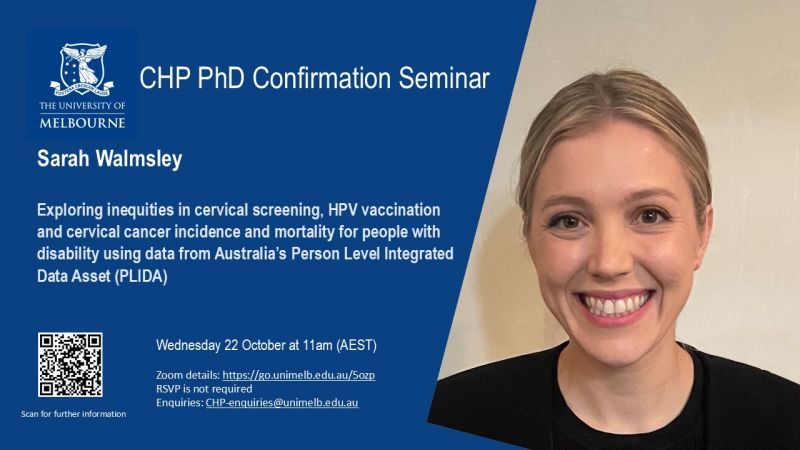
CHP PhD Confirmation Seminar - Sarah Walmsley
Share via
Title: Exploring inequities in cervical screening, HPV vaccination and cervical cancer incidence and mortality for people with disability using data from Australia’s Person Level Integrated Data Asset (PLIDA)
Zoom link: https://go.unimelb.edu.au/5ozp
Location: Seminar Room 410, Level 4, 207 Bouverie Street, Carlton
Supervisors: Associate Professor Zoe Aitken, Centre for Health Policy, Melbourne School of Population and Global Health; Professor Claire Vajdic, Kirby Institute, University of New South Wales; Dr Glenda Bishop, Centre for Health Policy, Melbourne School of Population and Global Health; Mr Robert Long, Australian Bureau of Statistics.
Bio: Sarah is a PhD student and research assistant at the Centre for Health Policy, Melbourne School of Population and Global Health. Sarah’s PhD focuses on addressing important gaps in knowledge to support equitable elimination of cervical cancer for people with disability in Australia.
Abstract: Cervical cancer inequities exist for people with disability globally, including lower cervical screening rates, lower coverage of human papillomavirus (HPV) vaccination, and increased cervical cancer incidence and mortality. In Australia there is a lack of national data on cervical cancer related outcomes for people with disability. People with disability are not comprehensively captured in a single data source that can be used to monitor these outcomes, and this contributes to the paucity of population-wide data for this subgroup on the topic. Linked data methods, that combine administrative data with health outcome data, provide a unique opportunity to explore outcomes for subgroups that may not be captured in standard data collections, including people with disability. Sarah’s PhD aims to explore inequities for people with disability along the cervical cancer pathway, spanning from HPV vaccination and cervical screening to cervical cancer incidence and mortality.