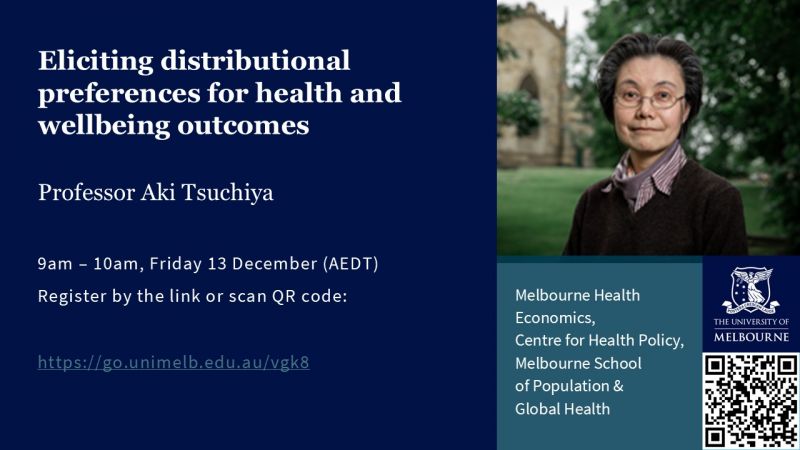
MHE Seminar Series: Prof. Aki Tsuchiya
Share via
Title: Eliciting distributional preferences for health and wellbeing outcomes
Bio: Aki Tsuchiya is a Professor of Health Economist based at the University of Sheffield, UK. She is interested in the elicitation and modelling of preferences for health and wellbeing. More recently, she has focused on distributional preferences, to look at how members of the public evaluate different distributions of health and wellbeing across society, and in particular, how they might trade-off between improving average population health and reducing inequalities in health.
Abstract: There is a growing empirical literature in health economics that elicits how members of the public trade-off between improving average population health and reducing socioeconomic inequality in health – or their aversion to socioeconomic inequality in health – for use in Distributional Cost-Effectiveness Analyses (DCEA). This distributional preference is likely to reflect judgements over the background socioeconomic inequality as well as health inequality. However, to derive in the inequality aversion parameter most studies fit the data to a symmetric Health-Related Social Welfare Function (HRSWF), which assumes anonymity, which may result in a systematic bias. We propose two approaches. One is to elicit distributional preferences for socioeconomic inequality in health and to fit the data to an asymmetric HRSWF that accommodates non-symmetric preferences across socioeconomic groups. This approach requires a measure of asymmetry. The other is to elicit distributional preferences for an overall measure of wellbeing that includes health and wealth and to fit the data to a symmetric SWF. This approach requires an overall measure of wellbeing. The talk will report from a suite of studies that explored the two approaches. The studies had three aims: (1) to examine whether public distributional preferences for health satisfy symmetry; (2) to explore eliciting symmetric inequality aversion in equivalent income, a preference-based measure of wellbeing; and (3) to better understand distributional preferences (i) by examining the reasons for distributional preferences qualitatively through online discussion groups, (ii) by comparing the reasons across the digital divide using telephone interviews of the digitally excluded, and (iii) by administering a large scale unassisted online survey to allow econometric analysis by respondent background etc.
Register: https://go.unimelb.edu.au/vgk8