Exploring Health Inequality Preferences in Australia and Canada
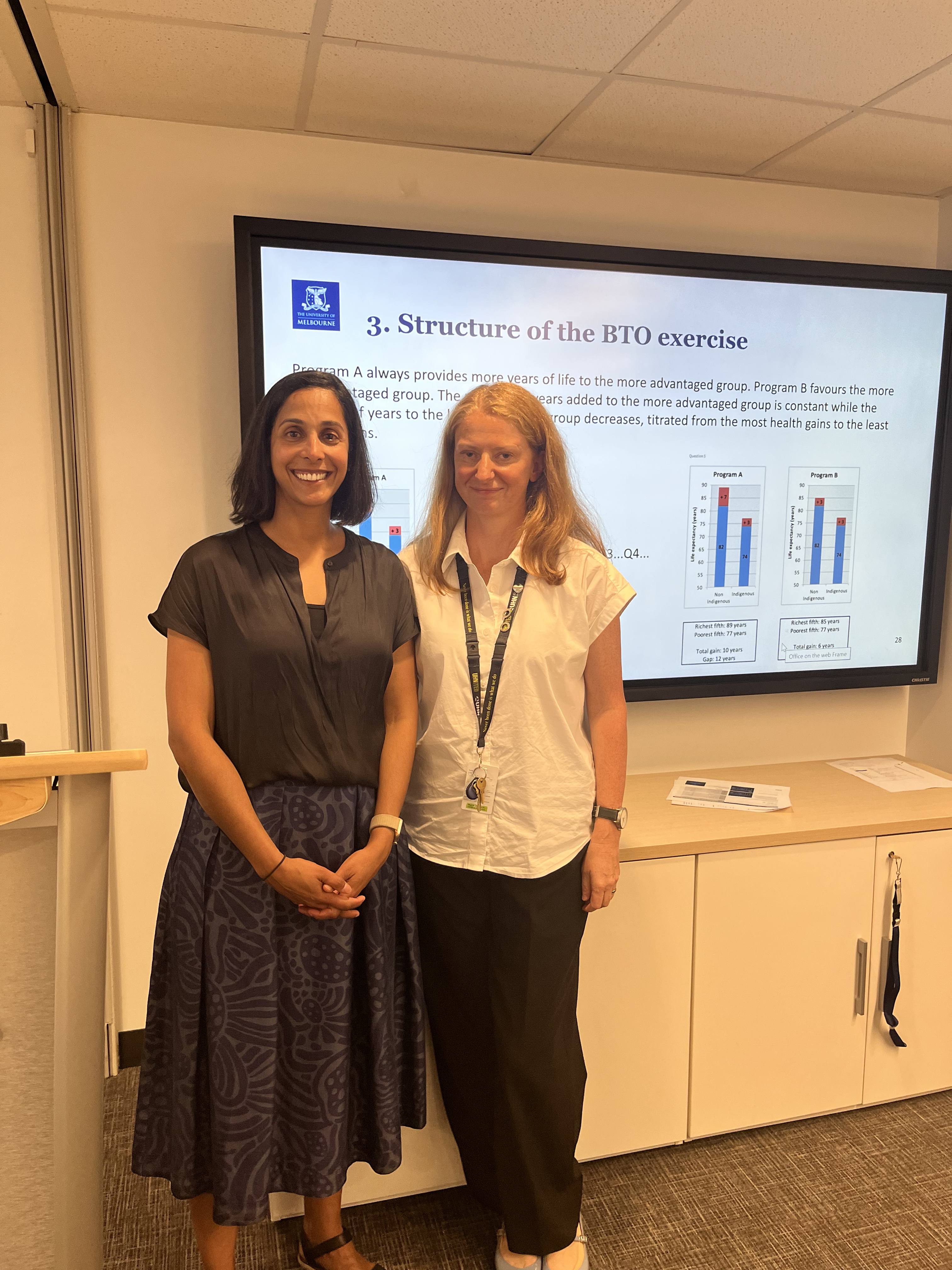
On July 10, 2025, A/Prof Natalie Carvalho, head of the Economics of Global Health and Infectious Diseases Unit, presented at the University of Toronto’s Health Systems and Policy Research Collaborative Centre Rounds. The session, titled "Understanding Population Preferences on Health Inequality: Comparing the Australian and Canadian Inequality Aversion Studies," focused on the critical role of health inequality considerations in policy decisions.
Session Overview:
Prof Beate Sanders presented a brief overview justifying the importance of equity informative economic evaluation and introducing Distributional Cost-Effectiveness Analysis (DCEA) - a method that quantifies the equity impact of different interventions.
A/Prof Natalie Carvalho provided an in-depth overview of the Australian health inequality aversion study (Boujaoude et al. 2025), exploring the Australian public’s views on trade-offs between reducing health inequalities and improving overall population health, using a benefit trade-off exercise developed by PhD student Marie-Anne Boujaoude. This study, based on a representative survey (n=3,105), examined levels of aversion to health inequality across three dimensions: income, ethnicity, and geography.
Alongside A/Prof Carvalho and Prof Sander presented the Canadian health inequality aversion study, which engaged 3,000 participants (Irragori et al 2025). The study compared equity-efficiency trade-offs across three types of programs: vaccine-related programs, generic prevention programs, and abstract policy scenarios.
Learning Outcomes:
The session emphasized key differences between traditional cost-effectiveness analysis and distributional cost-effectiveness analysis (DCEA). Participants gained insights into the types of trade-offs made in inequality aversion studies' benefit trade-off exercises and the level of aversion to health inequality based on population responses.
A/Prof Natalie Carvalho’s presentation added valuable depth to the conversation on equity in health economics, and we look forward to the ongoing impact of this work on advancing policy and research in this crucial field.