Miss Chatterbox: Crossing an ocean
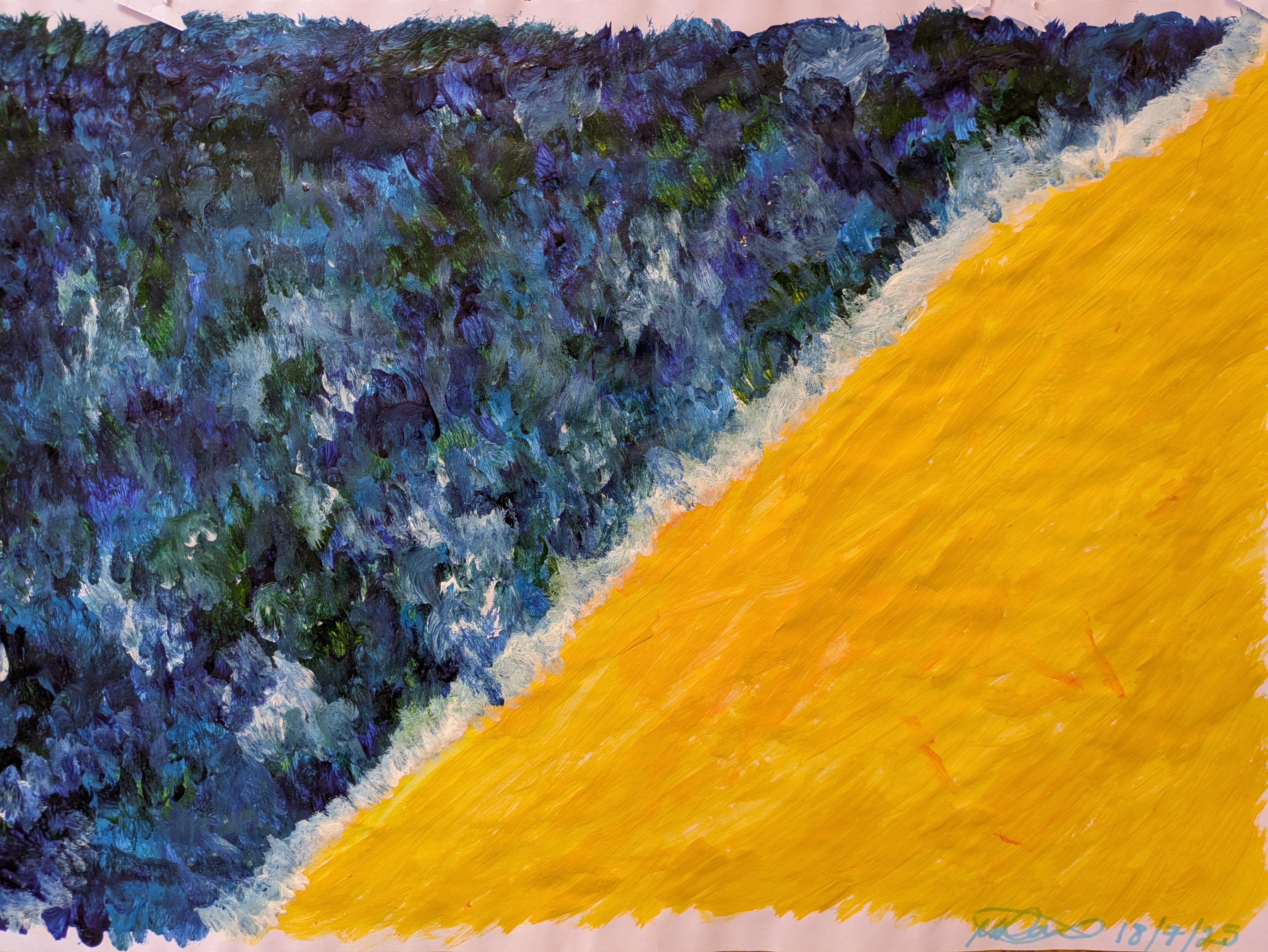
Ocean by Miss Chatterbox [acrylic painting]

Photographs by Miss Chatterbox [collage produced by the research team]
Transcript
It's really difficult to get to there [to ask for help] when you've got across this kind of ocean and that's a mental, emotional journey...
It took me 4 years to leave, from being consciously aware of what was happening, and then finding somewhere, finding people to trust who could help me. So it's a very grueling, slow process...
[my mother was] one of the main people to kind of say things like, ‘oh, oh, you know, your dad doesn't mean it.’ And you know all these different placating things, right? And so for a child growing up in a space like that, when you become an adult...who's going to ask for help? Because you've been brought up in this environment where the people who are supposed to be your first point of contact in a situation that's distressing or upsetting... To not be able to connect there. ...people don't go to their teachers at school because there's this fear... And as you get older and older, you become more aware of the fact that if you tell someone then that can create further consequences.
[It’s also] this very complex process of even like even reconciling the thought of leaving. Because just leaving isn't like, OK, I'm walking out the door. See you later. It's like. It comes with multiple decisions like do you leave and not talk to those people? Do you leave, have some space and then try and talk to them? Have relationships with them after? Do you leave and still have contact with them where they know where you're going and you're just like, ‘I just can't stay here’ and you kind of—not lie— but you do, in a sense, to protect yourself...like, ‘I just can't be here anymore... it’s just too noisy, I can't study, or whatever the excuses are. To just keep those relationships intact... It's becoming more and more known that coercive control doesn't just happen to the the other partner in a family domestic situation. Children are subjected to coercive control, so there’s many layers of leaving family domestic violence... Every step is an agonizing, you know, mental kind of [process].
you feel like you're in a room with 20 doors. And there's one door that you can open. That is the freedom door, let's say. But to get to that door, you have to go through all the 20 doors. You can't just go straight to that one because the path isn't straight. It's not linear. It's not... Accessible.
[Asking for help has] always been a really, like, huge anxiety for me. Because, you know, there was no care in that house for me. So I wasn't going to go to a mental health service, for example, and then have them placate that care with falsehood [like what happened at home]. That wasn't going to happen...
...It took me. Three years to go and have help for my mental health ... In that time, before professional support, I was leaning on two people. One was the same age as me and the other one was [a new friend] a bit older than me. ...I also had professional support at school, which was very life changing. Because I'd never had that...
Even the office ladies at reception knew what was going on because I would stay [on campus] for as long as possible. My teacher would drive me home because I didn't have my own car at the time. My teacher would pick me up [when] I would say, ‘I'm not coming in today because I’m too stressed and I just want to stay in bed’. She was like, ‘no, come to school. You'll be fine, you'll have a better day.’ Yeah. So there was a lot of—not forcing, but a lot of positive redirection from the people [there] who have lifted me up and told me and reassured me that I was OK, that I was doing the right thing, that I was going to like. I would be OK. I am strong, worthy. I don't deserve to be treated like a piece of dirt. All of these different things that they continuously said made a huge difference in me being able to even go and speak to, you know, places like White Lion or Melbourne City mission .