Pol.is conversation: Is less more?
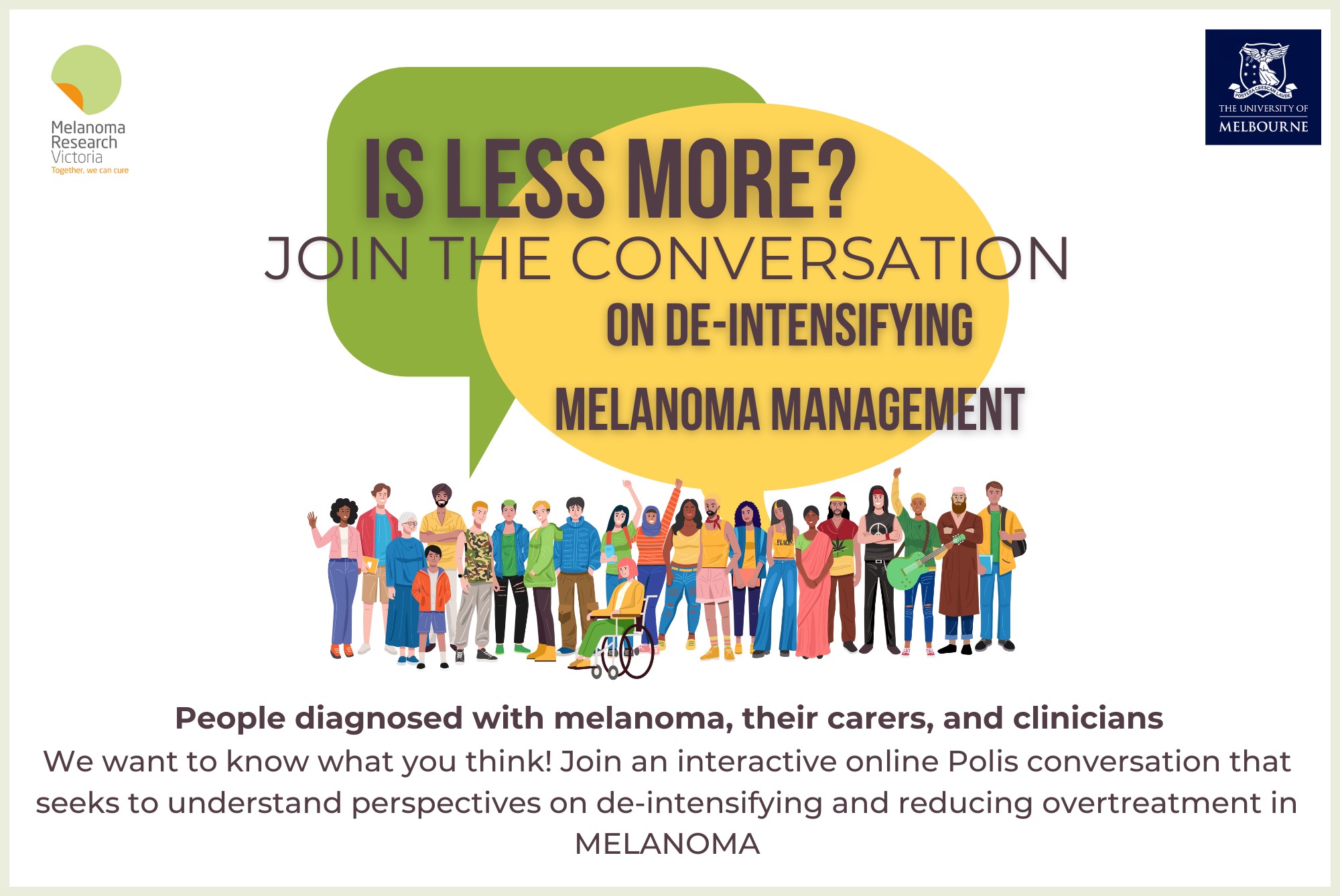
This study aims to understand the different views on how to approach de-intensification in the treatment of melanoma. We use Pol.is, a novel and interactive online platform to start this important conversation.
Thank you to everyone who has participated! This conversation has now closed.
You can see an initial report here.
Who should participate?
We welcome and invite individuals to contribute to the conservation:
- People with, or who have had, stage II to IV melanoma
- Caregivers of people with stage II to IV melanoma
- Healthcare professionals involved in the care of people with melanoma
You must live in Australia and be 18 years or older to participate.
-
People with melanoma and carers are directly affected by cancer treatments and their side effects.
Any de-intensification or de-escalation of therapy should consider the perspectives of the people affected and ensure that proposed strategies align with their values, preferences and quality of life concerns. Their views need to be considered when designing clinical trials and research that investigates de-intensification.
The insights of a lived experience help to identify practical issues and benefits that may not be evident in the clinical setting alone. Similarly, implementation of de-intensification strategies is unlikely to be successful without support from healthcare providers and prescribers.
It is important to understand the perspectives of all stakeholders so that any barriers to implementation can be addressed.
-
There are two parts:
- You will begin by completing an online survey with demographic questions. This information will help us better understand the perspectives of different groups.
- You will then be directed to Polis and asked to vote agree/disagree/pass on comments about de-intensification and melanoma treatment. You can contribute your own comments for others to vote on. Data visualisations provide real-time feedback.

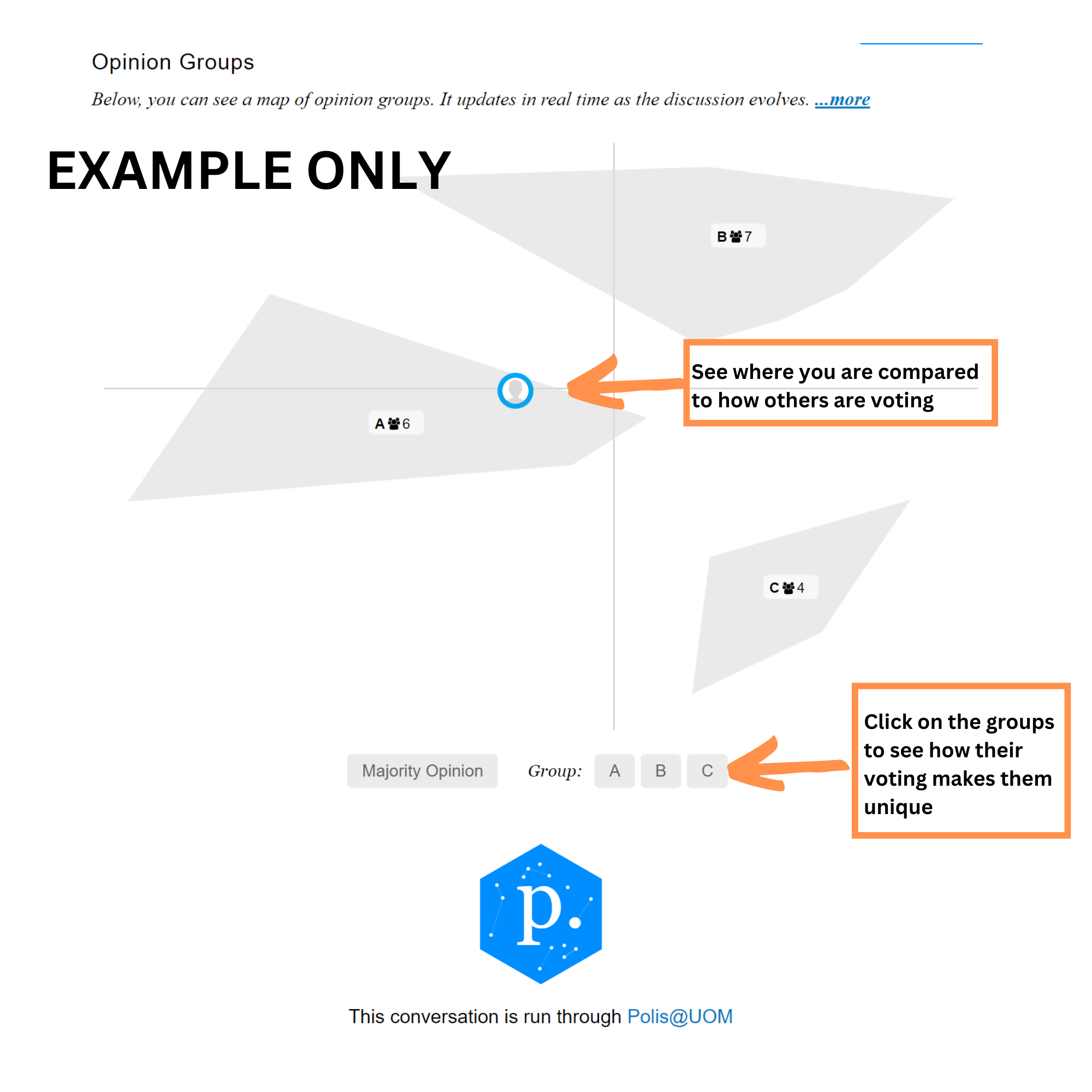
Participation is anonymous and we recommend spending at least 3 minutes at 3 different times during the conversation, which runs from September 2nd to 23rd.
Both parts of this study have been approved by the University of Melbourne Human Research Ethics Committee under project title “Is less more? Exploring consumer and clinician perspectives on de-intensification strategies in melanoma”, Project ID 29429, reference number 2024-29429-56329-5.
-
Pol.is is an online platform that helps large groups of people anonymously share their opinions and see how others feel about the same topics. Participants can submit their own ideas and agree or disagree with others. Pol.is then displays graphic charts to highlight the ideas most people agree on and those they don't, helping groups understand their collective views better.
Pol.is has mainly been used by governments and political groups to better understand the thoughts of their communities. Its use in healthcare research is less common. This national survey on de-intensification will be one of the largest uses of Pol.is in academic healthcare research.
More information on Pol.is can be found here.
-
You will not be personally identifiable in any results published from this study. Email addresses will be stored separately from responses. Data will be stored securely on a server at the University of Melbourne for the duration of the project, and for a further five years after the final publication, as per University of Melbourne guidelines.
This study (Project ID 29429) has been approved by the University of Melbourne Human Research Ethics Committee.
-
De-intensification or de-escalation in melanoma could look like:
- Lower dose of a medicine
- Less frequent dosing of a medicine
- Shorter duration of treatment
- Shortening treatment based on how a person responds to the medicine
- The use of tests (for example biomarkers) or decision tools to help select the right treatment for the right patient
- Leaving out a phase of treatment (for example surgery or medical treatment after surgery)
- Immunotherapy given before surgery to make the surgery or follow-up treatment less invasive
Reducing the intensity of melanoma management in the right situations may have substantial quality-of-life and resourcing implications for people with cancer, their carers, and society.
But there may be challenges to using less-intensive approaches in melanoma. These may involve:
- Lack of robust research, evidence or guidelines to support these approaches
- Lack of awareness of de-intensification approaches
- Communication between people with cancer and their clinicians
- Anxiety or fear of missing out or undertreatment
We need to understand what de-intensification means to those involved and how they feel about it so that we can improve future research and guide how we put de-intensification strategies into practice.
-
We worked with a panel of consumers from Melanoma Research Victoria to define the scope of this study and co-design the initial statements for this Pol.is conversation.
These statements will set the tone for the discussion. The consumer panel will also help share the study and interpret the results.
-
The Pol.is conversation will be strictly moderated. However there may be a small chance that you may experience some distress. Additional support may be found here:
- Melanoma Patients Australia: 1300 88 44 50
- Cancer Council: 13 11 20
- Lifeline: 13 11 14
- Beyond Blue: 1300 22 4636
The Pol.is timeline
- Monday 19 August 2024
-
You can now register to be part of the Pol.is conversation.
Once the conversation opens, you will receive a unique link via the email address you indicated.
- Monday 2 September 2024
-
The Pol.is conversation opens. You can now engage in the conversation!
You will be able to vote on comments about de-intensification and melanoma treatment. You can contribute your own comments for others to vote on.
- Tuesday 3 September to 22 September
-
Come back to the conversation and check what is new!
We advise you come back to see and vote on new comments submitted by the community.
- Monday 23 September 2024
-
The Pol.is conversation closes.
Thank you for participating!
Contact us
For more information, please contact Dr Jennifer Soon.
This project has human research ethics approval from The University of Melbourne (Project ID: 29429).
If you have any concerns or complaints about the conduct of this research project, which you do not wish to discuss with the research team, you should contact the Research Integrity Administrator, Office of Research Ethics and Integrity, University of Melbourne, VIC 3010. Tel: +61 3 8344 1376 or Email: research-integrity@unimelb.edu.au.
All complaints will be treated confidentially. In any correspondence please provide the name of the research team and/or the name or ethics ID number of the research project.