Can digital democracy help communities navigate environmental resilience challenges?
Digital democracy design for climate resilience: Crowdsourcing consensus, understanding division and supporting collective reflexivity
This project ran from 2022-2026. It explored democratic innovations designed to crowdsource consensus on contentious issues around disasters and climate change, using the digital democracy platform Polis.
Collective decision making is foundational to climate and disaster resilience. Yet communities encounter common pitfalls including: low levels of engagement; tendencies for disagreement to attract most attention while common ground is obscured; and inertia arising from complex distributions of agency and responsibility across individuals, organisations and governments.
The study piloted and evaluated two online participation processes using Polis, an open-source digital democracy platform which enables participants to respond to a prompt by submitting short, anonymous comments and voting (agree, disagree or pass) on comments from others. There is no direct reply button, reducing the conditions for interpersonal conflict while still allowing diversity of opinion to surface.
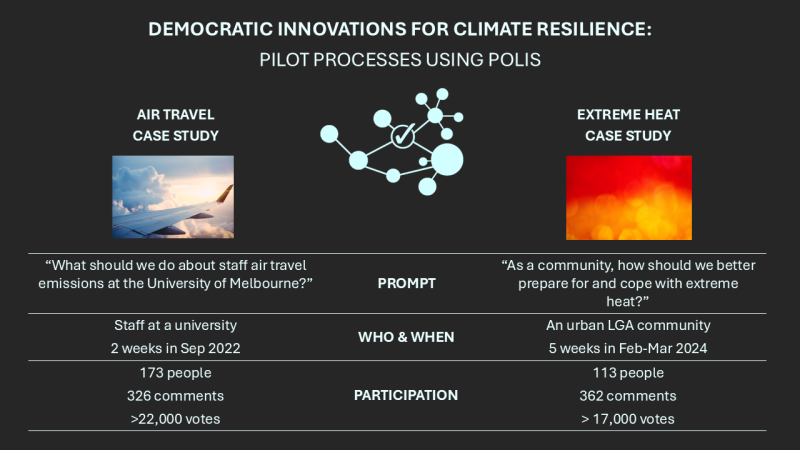
Two action research case studies
The research centred on two action research case studies in Australia where Polis was used for discussion of a climate-related issue (air travel emissions at a university, and urban heat in a local municipality). The aims in these pilot processes were to crowdsource ideas from many participants, reveal both diversity of opinion and points of consensus, and foster collective reflexivity. The research examined the extent to which these aims were realised in practice, and how this was shaped by design features (of the Polis tool and the processes for using it), context and the agency of those involved.
Key findings
Participation was active and sustained over multiple weeks, with many people returning multiple times. Combining both case studies, 286 participants submitted 688 comments and more than 39,000 votes. Most reported that the process was engaging and that they felt comfortable to express their views honestly.
Solution-oriented pluralism: the process enabled many ideas to be crowdsourced, while the votes provided insight into collective appraisal of the proposed actions. Strong lines of disagreement were particularly evident in the air travel case study, along with clear points of consensus, indicating low-hanging fruit for priority action. In the extreme heat case study, the more combative tone of a parallel discussion on Facebook provided a striking comparison.
Collective reflexivity: many participants learned from others’ comments and reconsidered where responsibility lies and reflected on opportunities for possible action.
Findings also highlight cautions, e.g.: Polis’ automated visualisations were useful in many ways, but careful human analysis was needed to draw out nuanced findings and reduce risks of misinterpretation.
A design-based model for understanding democratic innovations
Beyond the case study findings, this research offers a model of democratic design developed with the intention of supporting plurality in extending toolkits for working through collective action problems. The model of a democratic-artefact-in-practice integrates Saward's work on Democratic Design (2021) with affordance theory.
This conceptual model may be used for planning, implementing and analysing future democratic initiatives. Please contact Phoebe Quinn for further information.
Read more
A social media platform that is actually good for democracy? (Pursuit, 2024)
What should we do about staff air travel emissions? Crowdsourcing consensus and understanding division within an Australian university (Paper in Transportation Research Part D: Transport and Environment, 2025)
Can digital democracy help communities navigate environmental resilience challenges? (Poster, NHRA Forum, 2026)
Funders
University of Melbourne (Melbourne Climate Futures and Faculty of Medicine, Dentistry & Health Sciences) and Natural Hazards Research Australia
Investigators
Phoebe Quinn, University of Melbourne
Professor Lisa Gibbs, University of Melbourne
Professor Nicole Curato, University of Canberra
Professor Kathryn Bowen, University of Melbourne
Dr H. Colin Gallagher, University of Melbourne
- Contact Name
- Phoebe Quinn
- phoebeq@unimelb.edu.au