Posyandu Jalanan: Community-based maternal and child care for vulnerable populations in Yogyakarta, Indonesia
By Dr. Pritania Astari, Ahmad Syaifuddin and Prof. Linda Bennett
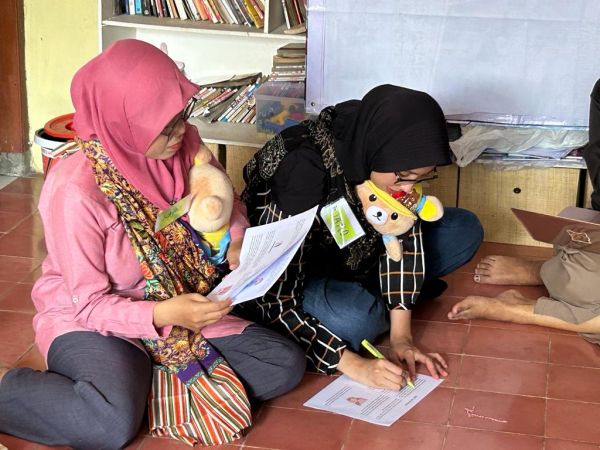
Workshop: Embodying young mother's worlds
From October 2023 to January 2024, the community-based organisation Harapan Fian collaborated with UoM researchers, Dr Pritania Astari and Prof Linda Bennett, with the support of a Centre for Health Equity Incubator Grant. The collaboration generated important insights into community-based model of maternal and child health care (MCH), which began in 2020 and has aimed to address health inequity among young mothers and their children who are situated on the streets of Yogyakarta, Indonesia.
Harapan Fian and UoM collaborators co-designed and co-facilitated six workshops to support Harapan Fian outreach workers to evaluate their street-based clinic called Posyandu Jalanan. The evaluation tool was developed by outreach workers and enabled young mothers to narrate their experiences of Posyandu Jalanan. The visual story telling tool was accessible for young mothers with limited literacy and allowed their stories to emerge through an interactive process that was informal and creative.
Four workshops focused on research capacity building and data analysis for community outreach workers, and two workshops were dedicated to supporting 17 street-based young mothers, who had given birth to their first child before the age of 19, to narrate their experiences. Culturally resonant pictures and drawings were used to depict a visual timeline describing mothers health concerns and health seeking experiences from pregnancy through to when their youngest child was aged two. Young mothers were supported through a buddy-model, where they were paired with an outreach worker they already knew, whilst constructing their visual narratives. Following the generation of the visual stories, participants were then invited to verbally describe their experiences, some chose to speak one-on-one, while other young mothers preferred sharing in a group.
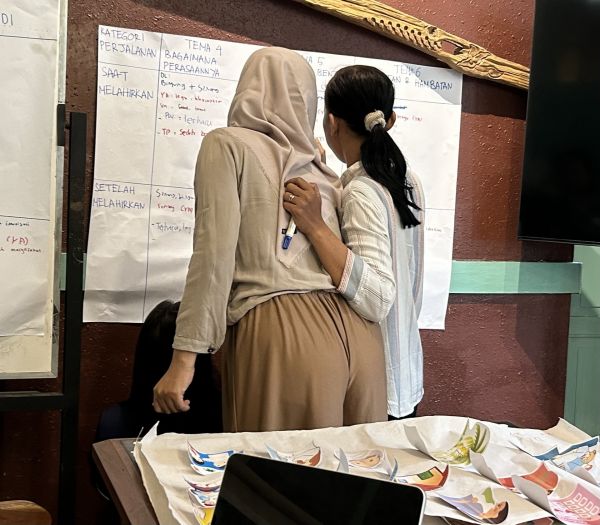
Workshop: Data analysis
Findings confirmed the types of support that young mothers required and had received from Harapan Fian. This included direct provision of health care, as well as physical, psychological, social, financial, and institutional support. Health care included: routine monitoring of children and their growth to ascertain nutritional status, support with breast feeding and alternatives, counselling on family planning methods, and advice on routine illnesses such as fevers and diarrhea. Physical support included provision of a safe space – at the CBO headquarters and during street-based MCH clinics. When referral to additional services, for health problems that required subscription medicines or for sexual assault and domestic violence were needed, outreach workers also provided transport and accompanied mother to these services.
The social and psychological support described included outreach workers actively listening to young mothers’ stories without judgement or stigmatizing responses, and the time flexibility of Posyandu Jalanan clinics, which run outside of typical working hours for street-based occupations. Including young mothers in the decision-making processes surrounding their choices of medical and social services was also noted as a difference between Posyandu Jalanan and mainstream health services. Young women reported receiving financial support in the form of covering medical bills for health care that was not free, and emergency financial support for mothers and children experiencing under-nutrition. Institutional assistance included supporting mothers to apply for legal identity documents, and subsequently membership in the national health insurance scheme.
In summary, the street-based Posyandu Jalanan model of MCH clinic was considered much safer than mainstream services because of the lack of judgement and stigma young mothers encountered when interacting with community outreach workers. Posyandu Jalanan services were also less expensive to access because the clinic came to the mothers, and the timing of clinics was considered highly convenient. The evaluation of young mothers’ experiences confirmed that this service model is highly suitable for vulnerable street-based populations and has significant potential for upscaling both locally and in other Indonesian cities with similar populations.