Centre for Health Equity Newsletter - May 2024

Letter from the Director

Happy Autumn to everyone associated with the Centre for Health Equity in the Melbourne School of Population and Global Health at the University of Melbourne. Welcome to our second newsletter this year which brings to you updates, information and news about health equity activities in MDHS and beyond.
This year on April 7th World Health Day the theme was My Health, My Right, with a specific focus on issues central to health equity. This year’s theme was chosen to champion the right of everyone, everywhere to have access to health services, education, and information, as well as safe drinking water, clean air, good nutrition, quality housing, decent working and environmental conditions, and freedom from discrimination. My Health, My right focuses on the rights of individuals to make decisions about their own health and to protect these rights to health as a basic human right. For governments, this means knowing the health needs of populations and acting on them, involving the general public in health decision making and legalising the right to health across all sectors.
On a related note, if you are interested in social justice issues in public health and you are a student at the University of Melbourne, the subject Health and Social Justice might be of interest to you. I am looking forward to it!
It is great to read news from our recipients of the 2023 CHE incubator scheme last year and how these projects are developing in different ways, with some great outputs in the form of publications, research grants submitted and student learning. Also, congratulations on the various papers and research outputs on topics of relevance to health equity.
This month we are happy to announce a call for expressions of interest in being part of a special issue in the new Taylor and Francis Journal of Health Equity. The theme is around data science and public health and we welcome papers that explore specific topics, develop novel methodological approaches or engage critically with data science from different disciplinary perspectives. Please see details below.
This month, there are a number of special days:
- Friday 17 May: International Day Against LGBTQIA+ Discrimination (IDAHOBIT)
- Tuesday 21 May: World Day for Cultural Diversity for Dialogue and Development
- Sunday 26 May: National Sorry Day
- Tuesday 28 May: Menstrual Hygiene Day
From Monday 27 May to Monday 3 June is Reconciliation Week and I would like to recognise that this year’s theme is Now More than Ever and emphasises the importance of our continued support and recognition of Indigenous social justice and health equity. The University has a number of activities during the week as does the City of Melbourne.
All the best to everyone and I hope you got a chance to glimpse the Aurora Australis.
Richard Chenhall, Director, Centre for Health Equity
Centre for Health Equity News
Announcing the Network for Collaborative Community-Consumer Partnerships
The CCP network aims to promote equitable and inclusive community engagement by bringing together researchers, educators, and policy makers at the school who are passionate about fostering collaborative partnerships with communities and consumers to improve health outcomes. It will provide opportunities for building capacity and capability in community-based research and practice, as well as knowledge exchange and skill-sharing.
To find out more about the network please send an email to mspgh-ccpnetwork@unimelb.edu.
Centre for Health Equity Incubator Scheme
In 2023 the Centre for Health Equity Incubator Scheme supported a number of innovative health equity projects. The purpose of the scheme was to enhance capacity and foster new strategic initiatives, collaborations, and leadership in health equity at the Melbourne School of Population and Global Health, supporting initiatives that prioritise the integration of health equity principles and methodologies into school endeavours. We caught up with some of last year’s grant recipients to see how their projects have been progressing.
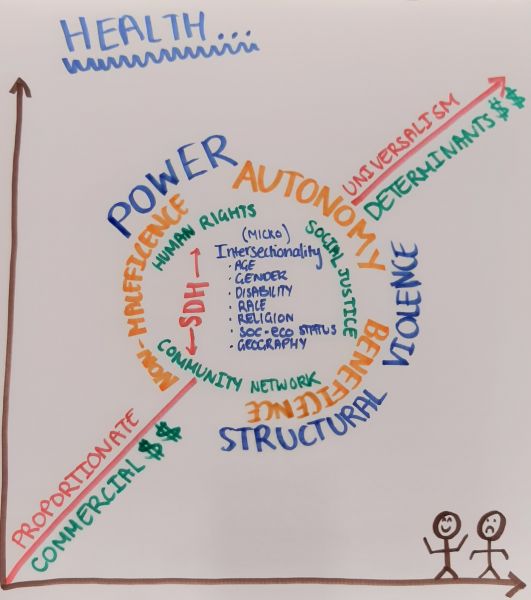
Concept map made by Ethics and Equity in Health and Medicine students
Building capacity in health equity for B.Biomed students
A/Prof Ros McDougall and A/Prof Karen Block have been delighted with the first run of their new subject ‘Ethics and Equity in Health and Medicine’, which is part of the public health major that MSPGH is now offering within the B.Biomedicine. With 37 students enrolled, the numbers far exceeded expectations, and the students’ enthusiasm has been fantastic. A special thanks to the staff members who contributed their time for engaging guest lectures (Prof Louise Keogh, Dr Mridula Shankar, Dr George Disney, and Dr Jenn Lacy-Nichols).
Student Inclusiveness and Cultural Safety in Group Assessment Tasks across MSPGH courses
Collation of feedback from the project's student advisory committee is complete, and data extraction from our literature review is at near completion. Once the literature review is complete, Karen Gregg and Helen Jordan, with advice from the student advisory committee, will produce recommendations and guidelines for subject coordinators on student group work assessment selection, development, implementation and evaluation.
Towards a better tomorrow: Addressing intersectional gendered power relations to eradicate inequities in maternal health
A/Prof Meghan Bohren, Prof Cath Chamberlain, Alya Hazfiarini, and colleagues’ paper ‘Towards a better tomorrow: addressing intersectional gender power relations to eradicate inequities in maternal health’ has been published as part of the Lancet-Global Health – eClinicalMedicine series ‘Maternal health in the perinatal period and beyond’. The series was sponsored by the World Health Organization, and launched via a webinar with over 300 attendees. A/Prof Bohren has also recorded a podcast and video with Lancet and WHO colleagues about the series.
Health equity for Indigenous menstrual health and hygiene
The Health equity for Indigenous menstrual health team (Prof Sandra Eades, Dr Tabassum Rahman, Prof Richard Chenhall, Dr Amie Bingham) undertook some scoping work related to the extent of current work around the issue of Indigenous menstrual health and wellbeing, establishing connections with researchers in other institutions who have been working on this topic. Currently, we are undertaking a review of clinical guidelines for the management of menstrual health and wellbeing in Indigenous populations, as well as using the platform of World Menstrual Health Day to engage with ACCHOs around the issue.
Tools for addressing inequity in digital health innovation
Our CHE incubator project (led by Dr Kara Burns and Dr Bronwen Merner) to complete a scoping review on Centering digital health equity during technology innovation is progressing well. The author team now comprises in excess of 20 co-authors, including from LMICs. The protocol for the review has been accepted for publication and a pre-print is now available. We are currently undertaking full-text screening for the review.
Reproductive Justice Hallmark Research Initiative
Building on the CHE Incubator grant, which funded a literature review exploring definitions of reproductive justice, we are thrilled to announce that Chancellery has funded a new Reproductive Justice Hallmark Research Initiative for 3 years. The Hallmark seeks to build a unified national research and advocacy agenda to progress reproductive justice in Australia. The initiative is chaired by Prof. Louise Keogh, convened by Dr Bronwen Merner and governed by a Steering Group of eminent University of Melbourne academics working in reproductive justice. To keep up to date with Hallmark events, please subscribe to our mailing list.
Staff Interests and Opportunities
EOI for Special Issue in New Journal of Health Equity on ‘Data Science and Health Equity’
Public health has always relied on data to understand health, illness and the burden of disease and the way in which data is collected, analysed and disseminated has become a vital component in improving health equity. With the prevalence of big data, computational approaches to analysis and the need for reproducibility in research, public health has embraced the approaches and methods of data science. Goldsmith and colleagues defined data science in public health as:
“Public health data science is the study of formulating and rigorously answering questions in order to advance health and well-being using a data-centric process that emphasizes clarity, reproducibility, effective communication, and ethical practices.”
Given the rapid growth in this area, public health experts are urging on caution and to promote ethical and responsible frameworks to inform data science. This includes for example the development of tools and approaches that ensure population representativeness and that identify racial and other implicit biases to avoid erroneous and harmful conclusions. It also includes questions related to how data were obtained and consent achieved, issues of rights and social justice in the use and governance of data and what goes unobserved in the complexity of optimising algorithmic criteria.
We have the opportunity to assemble a special edition for the new Journal of Health Equity on this topic and would welcome papers that utilise data science methods to examine public health topics that have relevance for health equity. We would also encourage methodological and concept papers that engage critically with data science and post positivist approaches in articulating a public health that is pro-equity.
Please submit an EOI with a title and a 250 word abstract here by end of day 29 May. For any questions please contact che-enquiry@unimelb.edu.au.
Global Conference on Migration & Health Equity: Call for Abstracts
Call for abstracts: 29 April – 10 June 2024
Notification of acceptance: 20 June 2024
Western Sydney University and the conference organising committee invite submissions of abstracts for presentation at the second Global Conference on Migration and Health Equity. The conference welcomes abstracts from anyone with an interest in migration and health equity including academics, higher degree research students, professionals, policy makers, practitioners, Think Tanks, community associations, and consumers. Presented data will inform better ways to bridge migration-related health divides and provide novel insights and usable knowledge in five themes:
- Migrant health during pandemics: Past, present, and future
- Global health leadership and health equity
- Migration, cultural capital, & settlement services literacy
- The Sustainable Development Goals and Health Equity
- Migration, the international law, and the rights to health
More information can be found here.
Co-Design Training for Researchers now available for staff on LMS
EMCRs often seek guidance in co-designing projects with community members to develop innovative solutions to complex social issues. Conventional research approaches generally involve designing solutions for the community, not with them, which risks research outcomes that are not wanted or needed. When done well, co-design approaches can lead to more relevant and effective research processes and outcomes, by working with the community to address their needs.
To address a lack of training in co-design among EMRCs, a team of researchers led by Dr Maya Panisset was funded by the University of Melbourne Researcher Development Unit to develop a suite of co-design resources, including this training package. The package was designed by Dr Souleymane Coulibaly, Dr Bronwen Merner and Dr Kara Burns in collaboration with Dr Maya Panisset, Dr Marianne Coleman, Dr Teralynn Ludwick, Dr Ceecee Britten-Jones, Dr Mahima Kalla, Ms Erin Davis and members of the steering committee.
More information and access to the training can be found here.
Upcoming Events
CDTH Special Seminar Series: Meaningful AI-Human collaboration for digital health: machine assisted topic analysis, social inequalities and bias mitigation
May 15, 2024 5:00 PM
Hear from Dr Paulina Bondaronek, Wellcome Trust Research Fellow, University College London, England as she speaks on the topic "Meaningful AI-Human collaboration for digital health: machine-assisted topic analysis, social inequalities and bias mitigation."
More information and registration can be found here.
Evolved gender roles: A cultural adaptation to coordinate the division of labour
May 15, 2024 12:00 PM - 1:00 PM
Old Arts Room 239 North Lecture Theatre or Zoom (Password if required: 831223)
In this week’s History and Philosophy of Science seminar hear from Cordelia Fine (History & Philosophy of Science, University of Melbourne), who will present ‘Evolved gender roles: A cultural adaptation to coordinate the division of labour’:
In debates about gender roles, evolutionary accounts are pitted against social constructionist accounts. In this talk I will propose a gender constructionist account of gender roles – not as a rival to an evolutionary account, but as an evolutionary account. This will build on the suggestion that gender roles evolved as a cultural adaptation to coordinate the division of labour, while drawing on the sociological concept of gender structure. I will also address two common objections to social constructionist accounts: that they are a theoretical impossibility; and that they are undermined by evidence from clinical populations with disruptions to early gonadal hormones.
More information about the programme can be found here.
VicHealth: Mobilising Research Efforts for Systems Change
Tuesday 28 May 2024 9:30 AM - 1:00 PM
State Library of Victoria (Isabella Fraser Room)
328 Swanston St Melbourne
An interactive forum to build collaborations and inform implementation of VicHealth’s new 10-year Strategy
VicHealth's approach is evolving from tackling individual behaviours and determinants of health to reshaping systems for a healthier, fairer Victoria. The recently launched 10-year strategy focuses efforts on three large systems: Neighbourhood and built systems; commercial and economic systems; and food systems.
Come and join VicHealth and other researchers to consider how to:
- Build new partnerships across research and non-traditional research boundaries
- Work alongside coalitions of change agents and innovators
- Turbocharge our knowledge translation
- Identify and share system shifts
- Shape VicHealth’s vision and approach to research and impact.
More information and booking link can be found here.
Upcoming Diversity and Inclusion Dates
As published by Diversity and Inclusion Council Australia.
Thursday 16 May: Global Accessibility Awareness Day (GAAD)
Friday 17 May: International Day Against LGBTQIA+ Discrimination (IDAHOBIT)
Tuesday 21 May: World Day for Cultural Diversity for Dialogue and Development
Sunday 26 May: National Sorry Day
Monday 27 May to Monday 3 June: Reconciliation Week
Tuesday 28 May: Menstrual Hygiene Day
Saturday 1 June to Sunday 30 June: Pride Month
Saturday 1 June: Global Day of Parents
Monday 3 June: Mabo Day (End of Reconciliation Week)
Thursday 20 June: World Refugee Day
Friday 28 June: Stonewall Riots Anniversary
Sunday 7 July to Sunday 14 July: NAIDOC Week
Sunday 14 July: International Non-Binary People’s Day
Articles of Interest
Health Equity and Access Weekly Roundup: May 11, 2024
Giuliana Grossi
The American Journal of Managed Care
The Gender Gap Ramps Up with Motherhood and Never Ends
Jennifer Ervin and Tania King
360info
Call for investing in understanding the health and well-being of South Asian migrants in Australia
Zohra s. Lassi, Ankur Singh and Soumyadeep Bhaumik
The Lancet Regional Health Western Pacific
Response to: 'Small numbers, big impact: making a utilitarian case for the contribution of inclusion health to population health in England' by Zhang et al
Alexander Charles Campbell, Jesse Young, Lucas Calais Ferreira, Lindsay A Pearce, Rebecca R Shuttleworth and Stuart A Kinner
BMJ Journal of Epidemiology & Community Health
Inmates face greater risk of reoffending if in poor health
Stuart Kinner
West Australian, Perth
How machine learning pinpoints origin of Legionnaires’ disease
Doherty Institute, The University of Melbourne and The Royal Melbourne Hospital
Making COP28 rhetoric a reality
Giorgia Dalla Libera Marchiori and Sharon Friel
The Lancet
Ensuring the Highest Attainable Standard of Health for Children Deprived of their Liberty
Tess Kelly, Alex Campbell, Jesse Young, Kate McLeod, Jacqueline Bhabha, Lindsay Pearce, Louise Southalan, Rohan Borschmann, Vijay Ratnam Raman, Stuart Kinner
Murdoch Children’s Research Institute, Justice Health Group, FBX Centre for Health and Human Rights at Harvard University
Rates and causes of death after release from incarceration among 1,471,526 people in eight high-income and middle-income countries: an individual participant data meta-analysis
Rohan Borschmann, Mortality After Release from Incarceration Consortium (MARIC) collaborators, Stuart A Kinner
The Lancet