Tobacco Control Interventions
SHINE Tobacco is a leading policy model aiming to provide evidence to support achievement of a global Tobacco Endgame
Overview
SHINE and the University of Melbourne’s Population Interventions Unit conducts research in many countries looking at the health and economic impacts of different tobacco control interventions.
This tobacco modelling was started by the BODE3 team (led by Tony Blakely and Nick Wilson) at the University of Otago and has been used for many years to model a variety of tobacco control policies in Aotearoa/New Zealand. This model was ranked highest in a 2023 systematic review of tobacco policy models.
SHINE-Tobacco has extended upon this work with the following innovations:
- Use of SHINE’s data pipeline to automate parameterisation of the SHINE-Tobacco model in different countries
- Expansion of modelled diseases to 31 tobacco-related outcomes (from 16 in previous iterations)
- Inclusion of a system that estimates smoking intensity and duration of smoking by cohort, for more accurate estimates of disease risk.
- Inclusion of a model to estimate smoking rates across a number of sociodemographic strata, to support analyses of multiple different groups (currently being implemented in the Australia Tobacco model expanded upon below).
SHINE-Tobacco is focused on interventions that would achieve a commercial ‘Tobacco endgame’, generally defined as interventions that would rapidly achieve less than or equal to 5% daily smoking prevalence in a population.
The work is funded by the University of Melbourne Research Training Program, NHMRC Centre of Research Excellence on Achieving the Tobacco Endgame (CREATE; GNT1198301), NHMRC Synergy Grant ( The Interdisciplinary Tobacco Endgame Research Network [INTER-Net]; GA294936), and through various Government and University collaborators.
For more information, read our
Tobacco Australia
SHINE’s Australia tobacco modelling is focused on determining the best strategy to achieve a tobacco endgame, both at the population level and across sociodemographic strata of geographic remoteness and SEIFA. With this equity focus in mind, SHINE has produced an optimization model that is able to combine sparse datasets reporting smoking prevalence across a number of strata and combine these estimates to produce a simulated dataset of smoking prevalence across all combinations of sex, age, remoteness, SEIFA, and Indigenous status. This model has been used to forecast smoking prevalence across sociodemographic groups in Australia and has indicated that a tobacco endgame is unlikely to be achieved by 2030 (the federal government’s target date). The goal is particularly out of reach for more disadvantaged groups, as shown in Figure 1 below. This work has been published in the International Journal of Epidemiology.
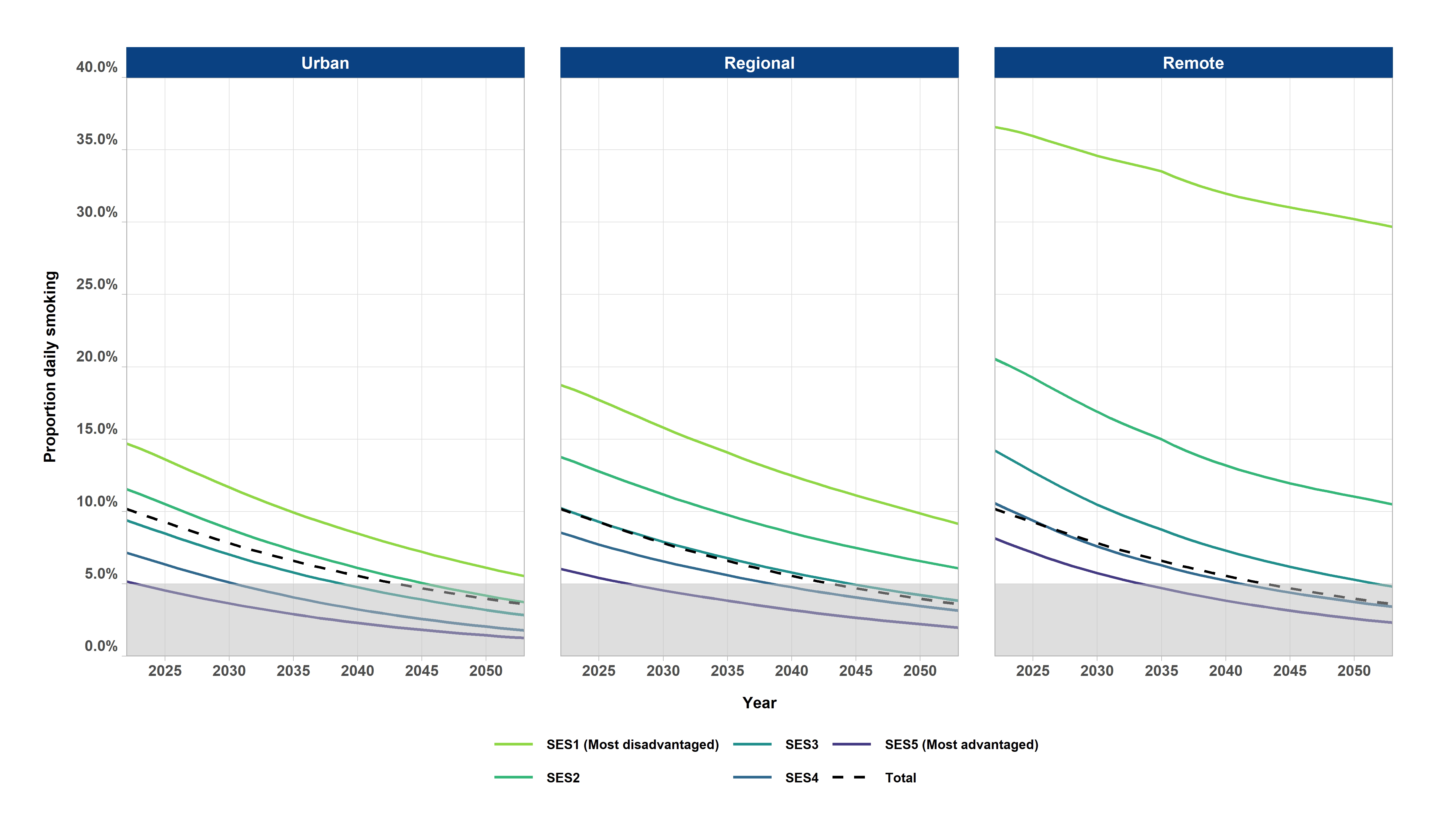
Figure 1. Daily smoking forecasts by remoteness and socioeconomic status (SES). Reproduced from Howe et al. 2025 (doi: 10.1093/ije/dyaf038).
SHINE is currently working on a combined smoking and vaping model that can be used to assess the impact of different tobacco control interventions on smoking behaviours, as well as possible ‘switching’ to vaping or use of tobacco products via the illicit market. A conceptual view of this model is shown in Figure 2.
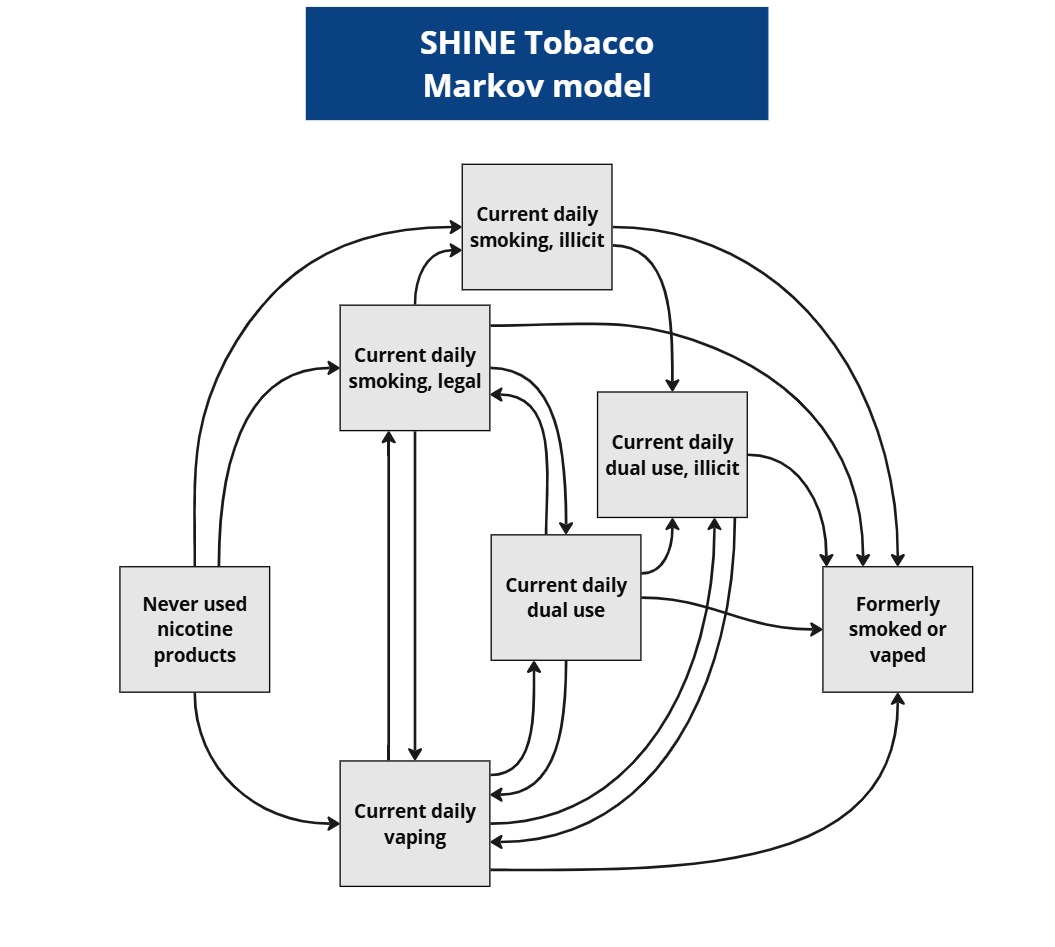
Figure 2. SHINE Tobacco Markov model. Arrows represent yearly net transitions between behaviour states (boxes).
In late 2024, SHINE was contracted by South Australia Health to model a ‘Tobacco free generation’ policy. The results of this work should be available mid-2025.
In 2025, SHINE will be expanding on this work, comparing several tobacco endgame interventions in terms of health and cost impacts at the population level in Australia, as well as by remoteness and SEIFA strata. The purpose of this work is to inform tobacco control policymaking for other states, and at the federal level. We are working with colleagues from the University of Queensland and Griffith University on this research.
Researchers
Tony Blakely, Driss Ait Ouakrim, Samantha Howe, Tim Wilson
Collaborators
University of Queensland, Griffith University
Funding
University of Melbourne Research Training Program (Samantha Howe – PhD candidate); NHMRC Centre of Research Excellence on Achieving the Tobacco Endgame (CREATE; GNT1198301); NHMRC Synergy Grant ( The Interdisciplinary Tobacco Endgame Research Network [INTER-Net]; GA294936)
Second Hand Smoke
SHINE received a seed grant from the NHMRC Centre of Research Excellence on Achieving the Tobacco Endgame (Early-to-Mid Career Researcher Seed Grant 2023-2024, CIA: Samantha Howe), to pilot a new model to estimate second-hand smoke exposure.
This work is ongoing in 2024-2025 and involves collaboration with the Healthy Housing Unit at the University of Melbourne, the University of Queensland, and Harvard University.
Related work led by collaborators from the University of Queensland, and contributed to by SHINE, has been published in early 2024.
Researchers
Driss Ait Ouakrim, Samantha Howe, Tim Wilson
Collaborators
University of Queensland, Harvard University
Funding
NHMRC Centre of Research Excellence on Achieving the Tobacco Endgame Early-to-Mid Career Researcher Seed Grant 2023-2024
Canada Tobacco
SHINE has engaged with researchers from the University of Toronto and the International Tobacco Control Evaluation Policy Evaluation Project based at the University of Waterloo, to model tobacco endgame interventions in Canada. This work follows on from previous modelling conducted in Aotearoa New Zealand (see below section).
This work is ongoing in 2024-2025 and is supported by The Manchester-Melbourne-Toronto (MMT) Research Fund 2024, and funding from the University of Toronto.
Researchers
Driss Ait Ouakrim, Samantha Howe, Tim Wilson
Collaborators
University of Toronto, International Tobacco Control Evaluation Policy Evaluation Project
Funding
The Manchester-Melbourne-Toronto (MMT) Research Fund 2024, University of Toronto
New Zealand Tobacco
SHINE modelling of tobacco endgame interventions on Aotearoa New Zealand was funded by the New Zealand Ministry of Health in 2022-2023. This work examined the health impacts and the economic impacts of the interventions that formed the Aotearoa Smokefree Action Plan, and contributed to the passing of this plan into law. While the legislation was repealed by the incoming government in 2024 before implementation, the SHINE team is still involved in producing policy-relevant modelling of smoking and vaping interventions in New Zealand. We are working with colleagues from the University of Auckland and University of Otago on this research.
Researchers
Tony Blakely, Driss Ait Ouakrim, Samantha Howe, Tim Wilson
Collaborators
University of Auckland, University of Otago, University of Queensland